Aug 9, 2021 | Puppy Training
 If you have a dog, or know someone with a dog you have probably heard about the importance of socialization! As new puppy owners, the term “socialization” gets drilled into your head. You MUST socialize this puppy otherwise it will be aggressive as an adult! Rescues often put in the description of their dogs who are either leery of humans or dogs (or aggressive towards them) that the dog was undersocialized as a puppy.
While we totally agree that proper socialization (key here is proper, and not just letting anyone and everyone tough and pick up your puppy, and definitely not taking them to the dog park) is super important, it may not be as crucial as you think. But how can that be? Socialization is the answer to all of your dog’s problems right? Nope! In fact over socialization is certainly a thing and cause it’s own set of issues. However, what we are talking about here is the fact that “training” and/or “socialization” cannot always and often does not override genetics.
Take for example children, sending them to school and doing all the extra curricular activities…while yes we should be getting our kids out and doing things with other people, these do not guarantee that your child will be an outgoing, super social butterfly who loves all the sports and activities. I myself attended public school, participated in countless activities (competitive dance, cheerleading, swimming, horseback riding, piano, skiing and more). I however, am extremely introverted, hate public speaking, have social anxiety and would take a small group of 2-4 people over a large party any day.
In fact, the thought of going to a large social gathering often makes me physically ill. My son who is now 6 attended daycare, preschool and Junior Kindegarten, played soccer, T-ball, took swimming lessons and gymnastics. He is also very shy, takes awhile to warm up to people and situations and would prefer 1-2 kids to play with than a big group. There are also plenty of people out there who did not participate in tons of activities, and many who were homeschooled and they are very outgoing, love big groups and gatherings.
Just like people, our dogs have their own distinct personalities. They are also specific breeds, and they are a product of their ancestors and genetics. On top of that, the real socialization window is actually from 3-14 weeks, so unless you are actively working on it then, you will just be training to undo whatever lack of socialization or bad experiences they had during that window. Due to this, finding a quality breeder who knows all about the critical window of opportunity is going to also play a huge role in who your dog becomes (but again not guaranteed because of course there are backyard breeders who have friendly dogs out there as well).
So while socialization is important, and proper socialization gives your puppy the best chance at being a well rounded adult dog, it does not guarantee they will love everyone and everything! We strongly suggest that you do focus on proper socialization to give your puppy the best chance at being a well rounded, friendly adult dog, remember that it does not guarantee anything!
Jul 8, 2021 | Dog Training
We often find that clients do not understand why their dog struggles with certain behaviours. Most of the time, the human has set a certain expectation, but the dog has not been properly prepared to meet it.
When no clear criteria have been set, not enough training time has been put in, and the dog is expected to perform too much too soon, failure is usually the result.
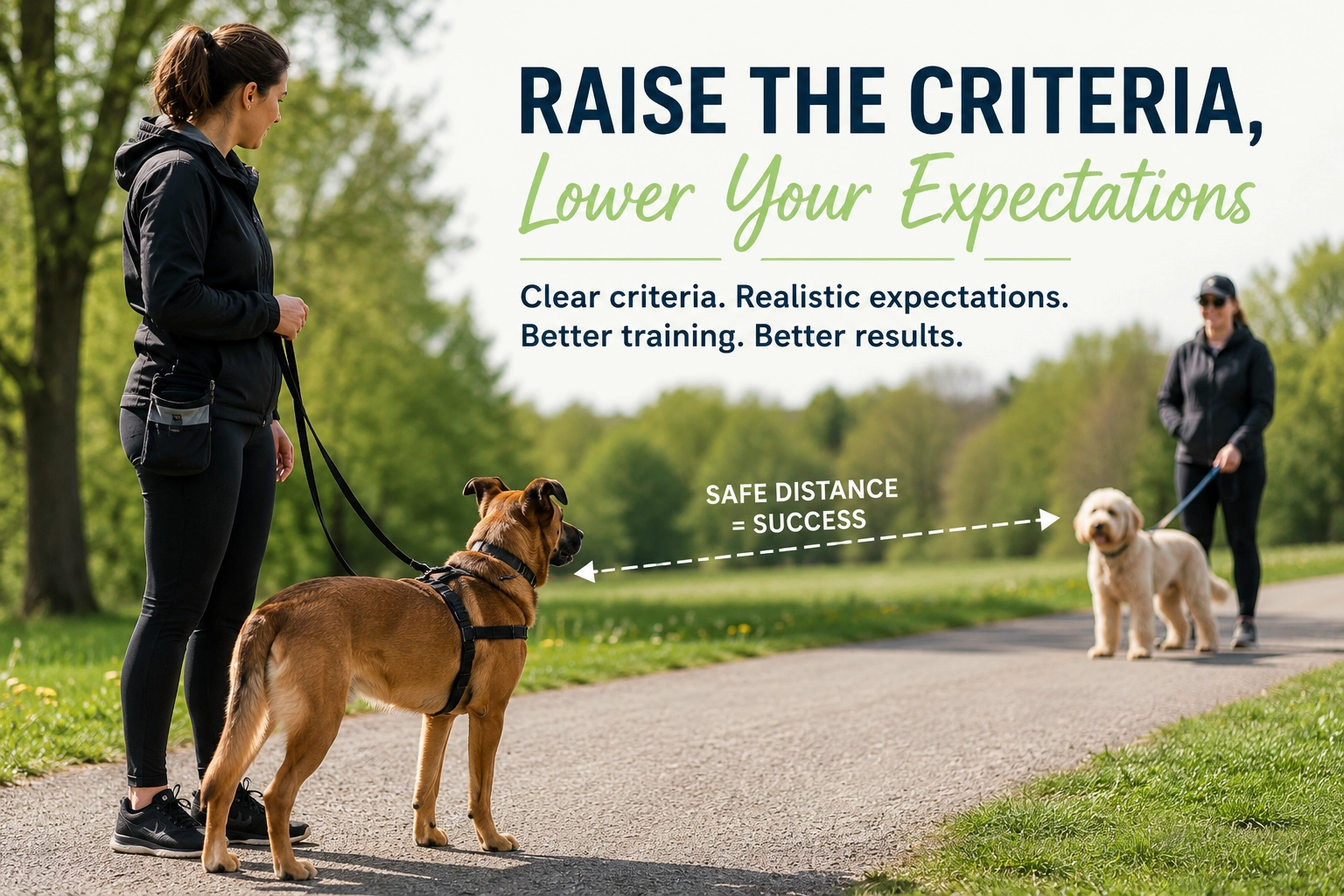
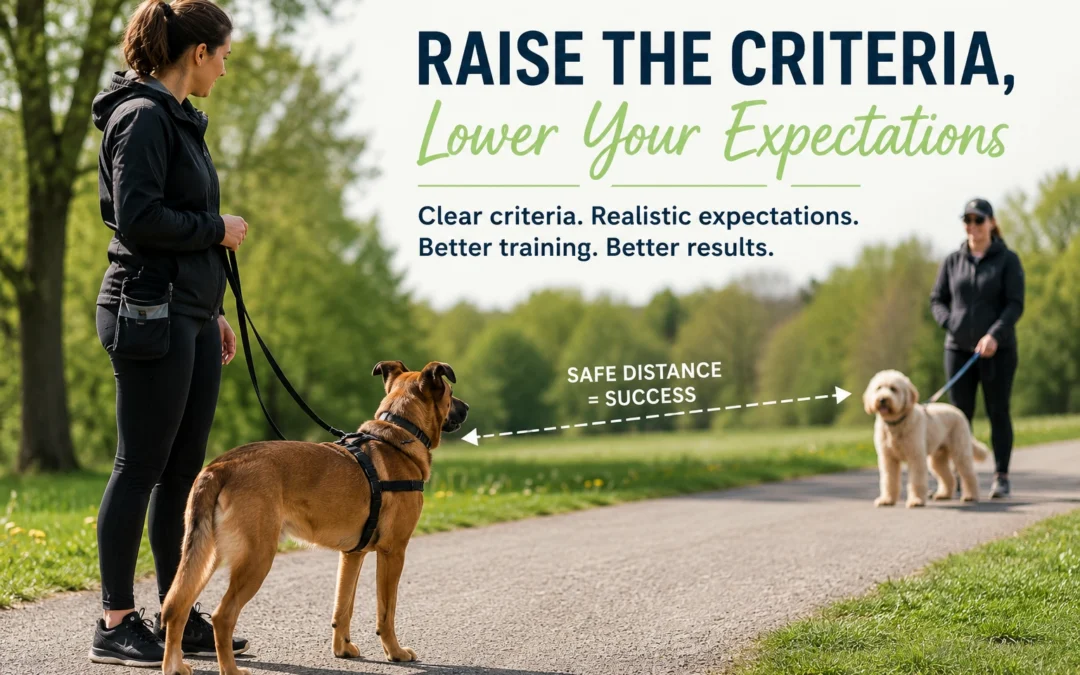
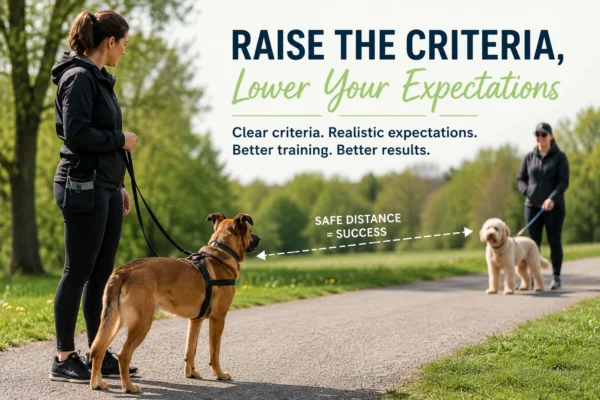
So how do we break this down and move past it? The answer is simple: raise the criteria, but lower your expectations.
What Does “Raise the Criteria, Lower Your Expectations” Mean?
In dog training, criteria means the standard you are asking your dog to meet. Expectations are what you believe your dog should be able to do in a certain situation.
When we talk about dog training criteria, we are talking about the exact behaviour we want from the dog. For example, staying calm, listening to commands, accepting food, holding a position, or continuing to move forward.
Raising the criteria means being clear about what behaviour is required. Lowering your expectations means setting up the situation so your dog can actually be successful.
Example: Reactive Dog Training on Leash
Let’s use the example of a dog who is reactive to other dogs while on leash.
Most owners know what they want. They want their dog to walk politely past other dogs. However, many owners do not know what the training criteria should be, and their expectations are often too high too soon.
When working with a reactive dog, we can raise the criteria by asking the dog to:
- Stay calm
- Listen to commands
- Accept food
- Keep moving
- Stay connected to the handler
However, in order for the dog to meet those criteria, we may need to lower our expectations about distance.
Book a Consultation
Distance Matters in Reactive Dog Training
If your dog loses their mind at 20 feet from another dog, cannot take food, cannot respond to commands, and cannot keep moving, then expecting success at 20 feet is unreasonable at that stage.
That does not mean your dog is bad. It means the setup is too difficult.
If your dog can stay mostly calm, accept food, listen, and keep moving at 40 feet, then that is where training should begin.
In that moment, you have raised the criteria but lowered your expectations. You are still asking for better behaviour, but you are setting the dog up at a distance where success is possible.
Progress Comes From Successful Repetition
As training improves, you can continue to raise the criteria. Over time, the dog may be able to stay calm, listen, accept food, and keep moving at a closer distance.
The key is to keep your expectations reasonable based on the amount of training your dog has actually done.
Good training is not about throwing your dog into a difficult situation and hoping they figure it out. It is about creating successful repetitions and slowly increasing the challenge.
Example: Teaching a Reliable Sit Command
Here is another simple example.
Let’s say you are working on your dog’s sit command. Your goal is for your dog to sit the first time you ask and hold the sit until released, even in public around distractions.
That is a great goal, but your dog may not be ready to do that in a busy environment yet.
Raise the Criteria
The criteria might be:
- Sit the first time I ask
- Hold the command until released
- Stay in position even with distractions
- Follow through when the leash is on
Lower the Expectations
If your dog struggles around people, you need to make the setup easier.
You may need to train farther away from the distraction, keep the leash on so you can follow through, and choose an environment where your dog can be successful.
You are not expecting perfection right away. But you are still maintaining clear criteria and helping your dog learn how to succeed.
Why Lowering Expectations Is Not the Same as Lowering Standards
Lowering your expectations does not mean allowing sloppy behaviour. It does not mean giving up on your goals.
It means understanding where your dog is in the training process and creating a setup that allows learning to happen.
You can still have high standards. You simply need to build toward those standards in a fair and realistic way.
How This Helps Your Dog Succeed
When you raise the criteria but lower your expectations, you make training clearer and less frustrating for both you and your dog.
Your dog learns what behaviour is expected, and you learn how to set up the environment so your dog has a better chance of making the right choice.
This approach can help with many training goals, including:
- Leash reactivity
- Loose leash walking
- Recall training
- Place command
- Sit and stay
- Impulse control
- Calm behaviour around distractions
- Better manners in public
Book a Consultation
Need Help With Dog Training Criteria?
If you are struggling with your dog’s behaviour, take a step back and ask yourself two questions:
- What exactly do I need my dog to do or not do?
- How can I make the situation easier so my dog can be successful?
Our dog training programs can help you choose the right training path for your dog’s needs.
For dogs who need one-on-one support with reactivity, leash manners, impulse control, or behaviour concerns, our Private Training programs are often the best fit.
If your dog is ready to learn around other dogs and people in a structured environment, our Group Classes can help build focus and obedience around distractions.
For dogs who need more mental and physical outlets, activities like Agility, Scent Detection, or structured Day Camp may also be helpful options.
Book a Consultation
If you are struggling with your dog’s behaviour, the best thing to do is take a step back.
Think about what you need your dog to do, lower your expectations to a level where your dog can succeed, and raise the criteria for the behaviour you are training.
Clear criteria, fair expectations, and consistent practice can make a major difference in your dog’s progress.
Contact us today if you need help creating a training plan that sets your dog up for success.
FAQ:
What does criteria mean in dog training?
Criteria means the specific standard or behaviour you are asking your dog to meet. For example, sitting when asked, staying calm, accepting food, holding place, or walking politely.
What does it mean to lower expectations in dog training?
Lowering expectations means making the training setup easier so your dog can be successful. This may mean increasing distance from distractions, choosing a calmer environment, or breaking the skill into smaller steps.
How can this help a reactive dog?
A reactive dog may not be able to stay calm too close to another dog. By increasing distance and setting clear criteria, you can help the dog stay calm, listen, accept food, and keep moving.
Is lowering expectations the same as allowing bad behaviour?
No. Lowering expectations does not mean lowering standards. It means setting up training in a fair way so your dog can learn successfully.
Can private training help with reactivity and behaviour problems?
Yes. Private training can help identify the right criteria, distance, structure, and training plan for your dog’s specific behaviour challenges.
Oct 27, 2020 | Puppy Training
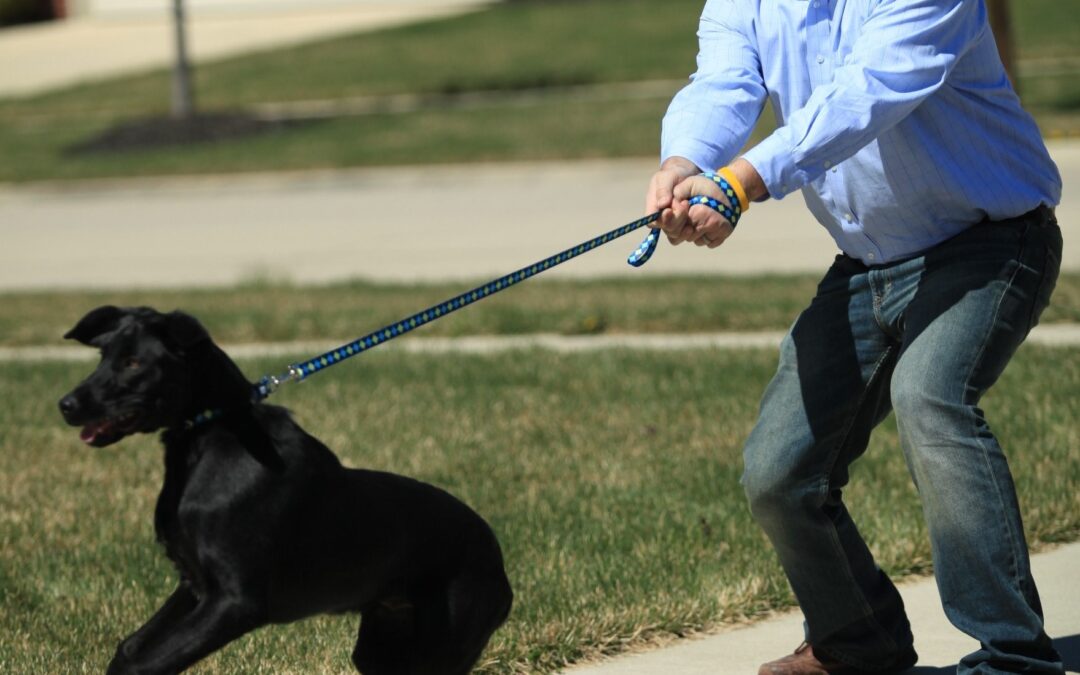
Leash reactivity…what is it? Does your dog have it? Is it aggression?
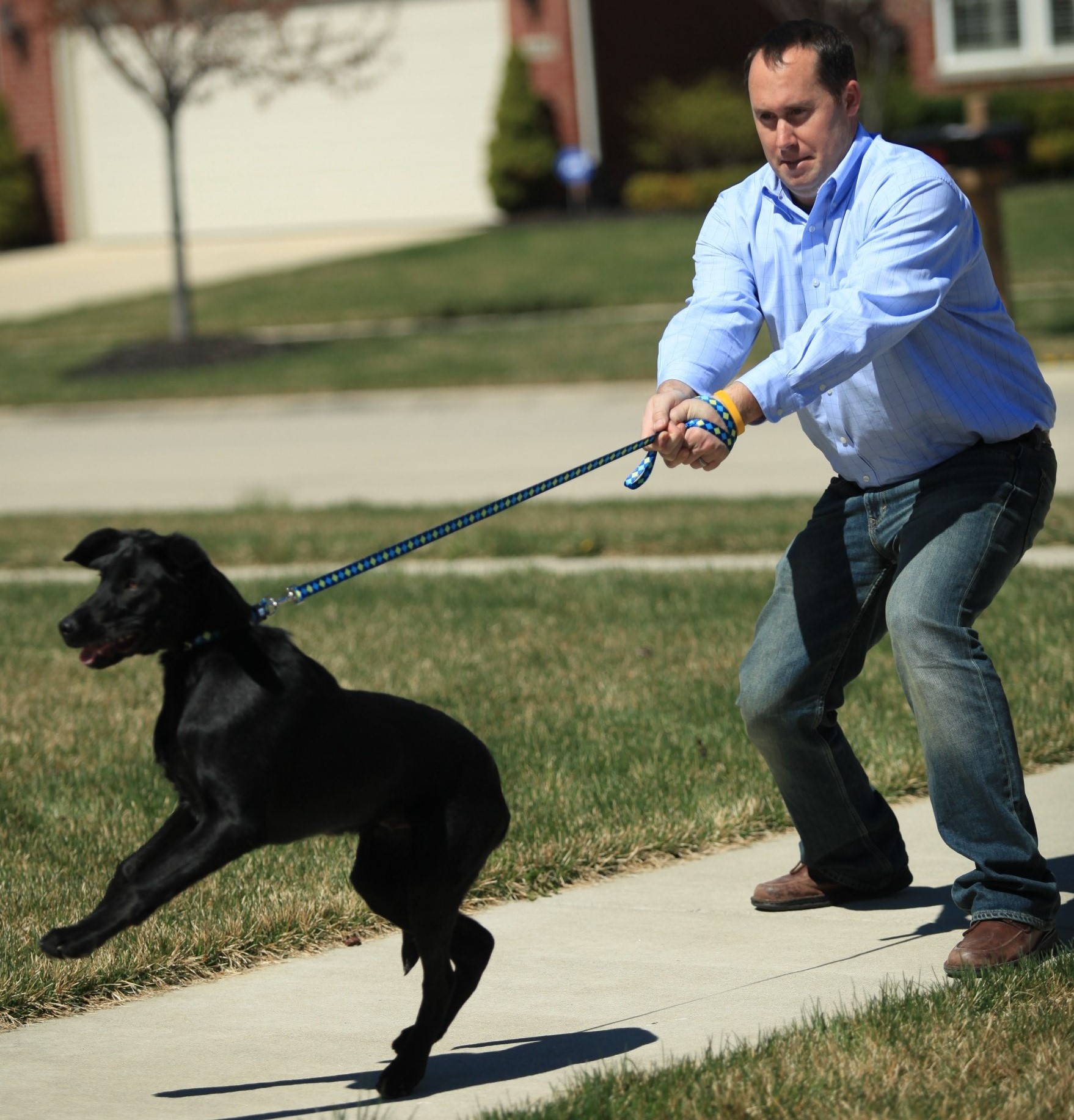
Leash reactivity is one of the most common challenges dog owners face. If your dog barks, lunges, or overreacts on walks, the good news is that this behaviour can be improved with the right training approach.
What Is Leash Reactivity?
Leash reactivity happens when a dog reacts to triggers—such as other dogs, people, or noises—while on a leash. Reactions can range from mild signs like stiff posture to intense behaviours like barking and lunging.
Importantly, leash reactivity does not always mean aggression. Many reactive dogs are simply excited, frustrated, or fearful.
Why Dogs Become Leash Reactive
1. Overexcitement
Some dogs become reactive because they are overly friendly and want to greet every dog they see. This is common in dogs that frequently visit dog parks or daycare.
2. Barrier Frustration
The leash acts as a barrier. When dogs cannot reach what they want, frustration builds and leads to reactive behaviour.
3. Fear-Based Reactivity
Fearful dogs may react aggressively to make a perceived threat go away. This often comes from past negative experiences or lack of socialization.
4. True Aggression
True aggression is rare but more serious. These cases often require long-term management and professional guidance.
How to Fix Leash Reactivity
Regardless of the cause, most successful training plans follow the same core principles:
1. Manage Distance (Threshold Training)
Work at a distance where your dog can stay calm. If your dog reacts at 35 feet, start training at 40 feet where they can still focus and learn.
If your dog is already barking or lunging, they are over threshold and cannot learn effectively.
2. Use Movement to Reduce Pressure
Keeping your dog moving helps prevent tension buildup. Standing still often increases frustration, while controlled movement keeps your dog more relaxed and focused.
3. Focus on Neutral Behaviour
The goal is not to force your dog to ignore everything, but to remain neutral. A healthy response is noticing a trigger briefly, then disengaging and moving on.
4. Use Timely Corrections (When Needed)
Corrections should be fair, well-timed, and used carefully. They are most effective before the dog escalates, not after.
However, relying only on corrections is rarely effective. Training should always include guidance and positive reinforcement.
5. Reward Good Choices
Reward your dog for calm behaviour, even small improvements. If your dog chooses to look away from a trigger or stay relaxed, reinforce that behaviour immediately.
You can also use simple cues like calmly naming what your dog sees (e.g., “that’s a car”) and rewarding calm responses.
6. Practice with Repetition
Consistency is key. Leash reactivity does not improve overnight, and regular practice is essential.
Set up controlled training sessions and gradually expose your dog to triggers while maintaining calm behaviour.
Fixing leash reactivity takes time, patience, and consistency. By managing distance, rewarding calm behaviour, and practicing regularly, you can help your dog become more relaxed and confident on walks.
The goal is not perfection—but steady progress toward a calm, neutral response in everyday situations.
What was your dog bred to do?


 View on goolge map