Jan 13, 2017 | Puppy Training
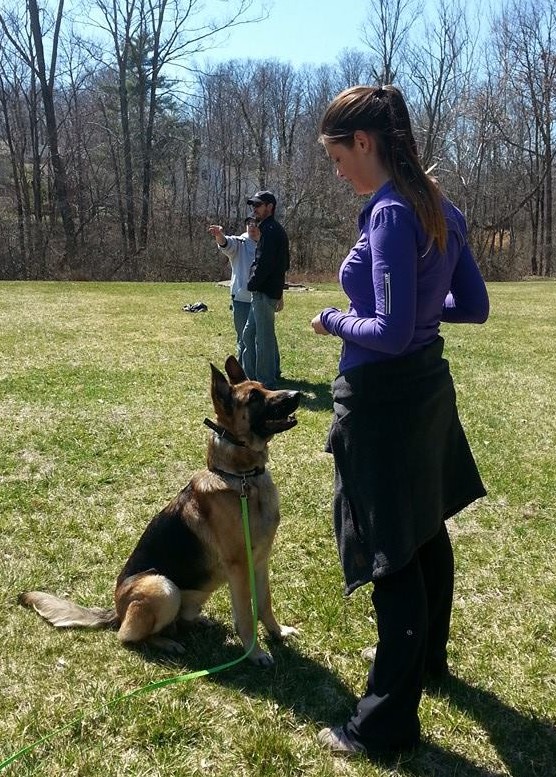
Many people assume that because I am a balanced trainer, I do not use food in training. The truth is that I do use food, but I use it differently than many people expect.
Food can be a very useful tool in dog training when it is used correctly. The key is understanding the difference between using food as a bribe and using food as a reward.
Using Food for Dog Training the Right Way
When it comes to using food for dog training, I do not want the dog to only listen because they see a treat in your hand. That can quickly turn food into a bribe.
Instead, I like to use the dog’s regular meal as a paycheque. This means the dog works for their food in a structured and meaningful way, rather than getting treats randomly or needing to see food before they respond.
Food Should Be a Paycheque, Not a Bribe
A bribe happens when the dog only performs a behaviour because food is being shown first. For example, if your dog will only sit when they see a treat in your hand, the food may be controlling the behaviour.
A paycheque is different. When food is used as a reward after the dog makes the right choice, it helps reinforce good behaviour without making the dog dependent on seeing food first.
This approach teaches the dog that listening, focusing, and making good choices can lead to something valuable.
Why Use Your Dog’s Meal for Training?
Using your dog’s meal during training can be a simple and effective way to build better habits throughout the day.
Instead of feeding your dog from a bowl with no structure, you can use part or all of their meal to reward behaviours such as:
- Eye contact
- Sitting calmly
- Coming when called
- Walking politely on leash
- Holding place or staying settled
- Practicing basic obedience
This helps make training part of your dog’s daily routine while still meeting their normal food needs.
Balanced Training Can Still Include Food
Being a balanced trainer does not mean avoiding food. It means using the right tool at the right time, based on the dog, the behaviour, and the training goal.
Food can be helpful for teaching, motivating, and rewarding dogs. The important part is using it with clear expectations, structure, and timing.
Food can be an excellent training tool when it is used properly. The goal is not to bribe your dog, but to reward good choices and build better behaviour over time.
By using your dog’s meal as a paycheque, you can create more structure, improve focus, and make everyday training more valuable.
If you would like help learning how to use food, structure, and clear communication in your dog’s training, our private dog training programs can help.
Book a Consultation
FAQ:
Should I use food for dog training?
Yes, food can be a very helpful training tool when it is used correctly. It should be used as a reward for good choices, not as a bribe.
What is the difference between a bribe and a reward in dog training?
A bribe is shown before the dog listens, while a reward is given after the dog makes the right choice. Rewards help reinforce behaviour without making the dog dependent on seeing food first.
Can I use my dog’s regular meal for training?
Yes. Using your dog’s regular meal for training is a great way to add structure and practice obedience without overusing extra treats.
Does balanced dog training use food?
Yes. Balanced training can include food, praise, structure, leash guidance, and other tools depending on the dog and the training goal.
Learn More:
Why is play important for your dog?
What was your dog bred to do?
Why obedience is not the answer to your problems
Dec 22, 2016 | Puppy Training
Are you expecting a baby and wondering how to prepare your dog for the new arrival?
Many expecting parents ask how to properly introduce their dog to a new baby once the baby comes home. In my opinion, it is not as simple as one perfect introduction. There are several important things you should begin working on long before the baby arrives.
When it comes to dogs and babies, preparation matters. The more structure, training, and boundaries your dog has before the baby comes home, the easier the transition will usually be for everyone.
Preparing Your Dog Before the Baby Arrives
Many people plan to bring home a baby blanket for the dog to smell before the baby arrives. Others play baby crying sounds to help the dog get used to the noise.
I do not think either of those things will hurt, but I also do not believe they guarantee that the transition will go smoothly. Of course, when working with animals, there is never a guarantee with anything.
Instead, I recommend focusing on practical training skills and clear household expectations before the baby comes home.
5 Things to Teach Your Dog Before Bringing Home a Baby
The following skills are useful for all dogs, whether or not there is a baby on the way. However, they become even more important when children are going to be involved.
Start as early as possible. The sooner you begin, the easier it will be to enforce these rules once the baby arrives.
1. Teach Your Dog to Walk Nicely on Leash
Even with a new baby at home, your dog will still need exercise, structure, and mental stimulation.
If your dog is dragging you down the street, you will be much less likely to walk them, especially when you also have a stroller. Many behaviour problems can become worse when dogs do not get enough exercise or mental engagement.
A proper loose leash walk can make a huge difference, especially for dogs with high energy. It is also a good idea to practice walking with the stroller before the baby arrives so your dog is already familiar with the setup.
2. Stop Jumping Immediately
If your dog jumps on people, this behaviour needs to be addressed immediately.
It does not matter if your dog is big or small, friendly or not. There should be zero jumping on people, especially when a baby will be in the home.
This also includes jumping on people when they are sitting on the couch. I am not opposed to dogs being on furniture if they are polite and respectful. However, dogs still need boundaries and should respect personal space.
If your dog jumps all over you, jumps on guests, or jumps on people when they sit down, now is the time to stop that behaviour.
3. Address Resource Guarding With a Professional Trainer
If your dog guards any resources, you should work with a trainer who has experience with this issue.
The most common type of resource guarding is guarding food. Your dog should learn not to stress when people are near the food bowl.
If your dog guards furniture, such as growling or biting when you go near them on the couch or ask them to get off, then furniture privileges should be removed.
For safety, high-value bones or treats should only be given in a safe space, such as a crate or separate room.
4. Set and Enforce Rules and Boundaries
Before the baby arrives, decide what household rules you want your dog to follow.
For example, if you do not want your dog upstairs or in the baby’s room, set that rule now and enforce it consistently.
Whatever rules you choose, consistency is very important. Dogs do best when expectations are clear and predictable.
5. Teach the Place Command
The place command is one of the most powerful commands you can teach your dog.
Place means your dog goes to a specific object, usually a dog bed, and keeps all four feet on it. But place is more than just a position. It is also a state of mind.
Your dog should learn that place means calm, settled, and out of the way.
This command can be incredibly helpful when you are feeding the baby, welcoming guests, cleaning, or simply needing your dog to relax. It may feel frustrating before it becomes easy, but it is absolutely worth it in the long run.
Introducing Your Dog to the Baby
Once it is time for the baby to come home, the introduction should be calm, quiet, and controlled.
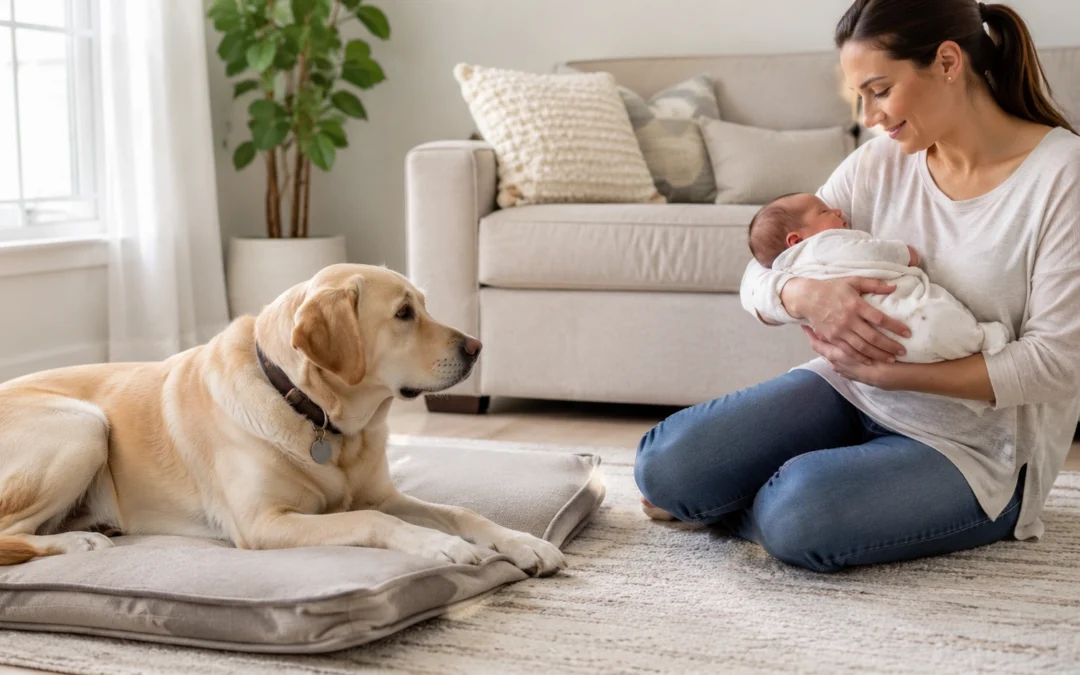
I suggest having your dog on leash and on place when the baby arrives home. Keep your dog there until everyone is settled and the initial excitement of coming home has passed.
Only once things are calm should you release your dog from place.
Do Not Force the Introduction
Try your best not to be nervous or anxious, as your dog can feed off your emotions.
Do not force your dog to sniff the baby. Do not bend down and push the baby toward the dog, and do not place the car seat on the floor for the dog to investigate.
The first introduction should be calm and low-pressure. You can sit down with the baby while your dog remains on the floor. The less of a big deal you make it, the better.
If your dog tries to jump up or becomes too excited, the leash allows you to guide them into a better decision. You can also send your dog back to place if needed.
Allow Short and Calm Sniffing Over Time
As your dog shows that they can remain calm around the baby, you can allow brief sniffing.
Keep it short and sweet. If your dog becomes overly excited, stop the interaction and put them back on place to calm down.
This process may take some time. That is okay. Going slowly is usually the best way to help your dog adjust successfully.
Do Not Forget Your Dog’s Needs After the Baby Arrives
After the baby comes home, it is important to continue meeting your dog’s needs.
A new baby can be overwhelming, but it is not a reason to ignore your dog. Simply putting your dog outside in the yard is not enough exercise or stimulation.
If your dog does not receive enough attention, structure, exercise, or mental stimulation, you may begin to see unwanted behaviours appear.
In most cases, dogs still need two walks per day and some playtime, even when life gets busy. There are very few exceptions to this rule.
Always Supervise Dogs and Babies
Once your dog and baby have been introduced and everything seems to be going well, supervision is still required.
Even the gentlest dog has the ability to make a bad decision. For that reason, you should never leave a dog and baby alone together.
There are no exceptions to this rule.
Need Help Before Your Baby Comes Home?
If you need help with training before your baby arrives, please contact us as soon as possible.
Giving yourself enough time to train will help set both you and your dog up for success. Whether your dog needs help with leash manners, jumping, boundaries, place command, or general behaviour, training before the baby comes home can make the transition much easier.
Our private dog training programs can help you prepare your dog for this important life change.
Book a Consultation
Happy Training!
Katherine
FAQ:
How should I prepare my dog before bringing home a baby?
Start by teaching important skills such as loose leash walking, no jumping, clear boundaries, and the place command. It is also important to address resource guarding with a qualified trainer before the baby arrives.
Should I let my dog smell a baby blanket before the baby comes home?
You can let your dog smell a baby blanket, but it should not be the only preparation you do. Practical training, structure, and boundaries are much more important for long-term success.
How should I introduce my dog to my newborn baby?
Keep the introduction calm and quiet. Have your dog on leash and on place when the baby comes home. Do not force sniffing or interaction. Allow short, calm introductions over time.
Can I leave my dog alone with my baby?
No. Dogs and babies should always be supervised. Even a gentle dog can make a poor decision, so a dog and baby should never be left alone together.
Why is the place command helpful with a new baby?
The place command gives your dog a clear job and a calm space to settle. It is especially helpful during feeding, visitors, busy moments, or times when your dog needs to be out of the way.
Learn More:
Using Food for Dog Training the Right Way
Teaching Impulse Control through Play
6 Tips for Teaching a Solid Recall (coming when called)
Dec 17, 2016 | TESTIMONIALS
Megan and Larry contacted us to help with their two female, littermate, Bulldogs Jo and Lucy, who were reactive on leash, and showing some unwanted behaviours in the house which was resulting in fights between the girls. Training is still ongoing for Jo and Lucy to help them learn to get along better in the house but since we started training the fights have gone from weekly to very rare!
“I just wanted to say thank you so very much for all your help with the girls! I was very nervous about moving to a busier neighborhood and having to walk them, but they have been amazing on walks!! I had both out and by accident walked through Gage park when the holiday train was there, hundreds of people and dogs and loud noise and they were great! The other night I had both dogs out again by myself for a walk, we must have passed 12+ dogs and not one outburst or growl or pull! We actually have the better trained dogs in our new neighborhood. It feels so good to be able to walk them and not feel nervous or stressed!”
Meaghan with Jo and Lucy in Dundas, Ontario
Dec 16, 2016 | TESTIMONIALS
Marlene contacted us for help with her two dogs, but primarily with Moxxie her 3 year old King Charles Cavalier Spaniel mix. Moxxie was dealing with some intense anxiety, which was causing her to bark excessively (all the time), and generally be all over the place anytime her environment changed. It got to the point that Marlene couldn’t walk her, and Moxxie was causing stress in the home because of her behaviour. We worked on teaching Moxxie how to calm down, giving her rules and structure, and helping her become more confident even in stressful situations. Check out what Marlene had to say after our last session!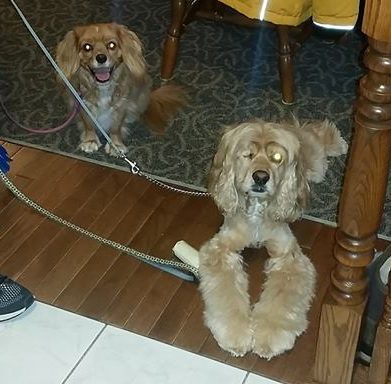
“Just wanted to let you know about the awesome walk we had today. Moxxie is doing good, we met two dogs on the sidewalk moved over as much as I could but the other dogs were on long leashes the owner made no attempt to pull them in. Moxxie let the other dog come right up to her and she didn’t even freak out, we just kept walking. Later two dogs were barking at us though the fence, one bark and I gave her a little pull on the collar, she stopped just like that kept right walking. We also did some sitting on the bench down town, she sat down even before Dante. Thanks again for making me want to take my dog out in public again.”
Another email from Marlene…
“I actually took Moxxie into the pet store this morning . The last time I took her she was just crazy . I still can’t believe how good she was this morning . She waited at the door before we entered then we did a walk around the store. No pulling or jumping on my legs just a nice calm walk around.”
Marlene with Moxxie in Grimsby
Aug 23, 2016 | Puppy Training
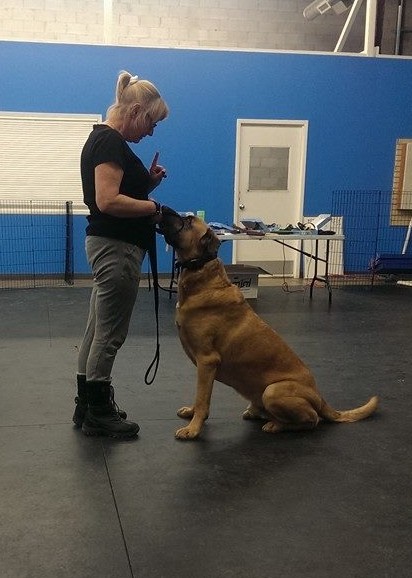
Bear has crazy high ball drive. He would literally play fetch all day if he could. It is almost obsessive, really.
For dogs like Bear, play is not just play. It can also become an excellent opportunity to teach focus, patience, and better decision-making. That is why we are working on impulse control through play using the controlled retrieve.
Teaching Impulse Control Through Play
Many high-drive dogs love toys, balls, tug, or fetch so much that they struggle to think clearly when the game starts. They may bark, jump, grab, chase too early, or become overly excited before you even throw the ball.
Instead of removing play completely, we can use that motivation in a more structured way. Teaching impulse control through play helps the dog learn that calm behaviour, listening, and waiting are part of the game.
What Is a Controlled Retrieve?
A controlled retrieve is a structured way to play fetch. The dog does not simply chase the ball whenever they want. Instead, the dog learns to wait, listen, retrieve when released, return the item, and stay engaged with the handler.
This teaches the dog that access to the ball comes through self-control. For a dog with strong ball drive, the ball becomes a powerful reward, but the dog must use their brain before getting it.
Why High-Drive Dogs Need Impulse Control
High-drive dogs often have plenty of energy and enthusiasm, but they may need help learning how to control that energy. Without structure, excitement can quickly turn into frustration, jumping, barking, grabbing, or ignoring commands.
Impulse control training helps dogs learn how to pause, think, and make better choices even when something exciting is happening.
This type of training can be especially helpful for dogs who struggle with:
- Obsessive ball or toy drive
- Jumping or barking before play starts
- Grabbing toys from the hand
- Ignoring commands when excited
- Difficulty calming down after play
- Over-arousal around toys, people, or other dogs
Using Play as a Training Tool
Play should be fun, but it should also have rules. When dogs understand the rules of the game, play becomes safer, more productive, and more rewarding for both the dog and the handler.
For Bear, the goal is not to take away his love of fetch. The goal is to teach him how to control himself around something he loves.
When done properly, controlled play can build better obedience, stronger focus, and a calmer state of mind.
More Training Options for High-Drive Dogs
If your dog has a lot of energy, strong toy drive, or trouble settling, structured training can help teach them how to use that energy in a better way.
Our dog training programs can help you find the right training option for your dog’s needs.
For dogs who need one-on-one support with impulse control, over-arousal, jumping, or listening around distractions, our Private Training programs are a great place to start.
If your dog would benefit from learning around other dogs and people, our Group Classes can help build better focus in a structured environment.
High-drive dogs may also enjoy healthy outlets such as Agility or Scent Detection, where they can use their energy and brain in a productive way.
For dogs who need structured activity during the day, our Day Camp may also be a helpful option.
Teaching impulse control through play is a great way to help high-drive dogs learn patience without removing the things they love.
For Bear, the ball is highly rewarding. By using the controlled retrieve, we can turn that excitement into a training opportunity and help him build better focus, self-control, and listening skills.
If you need help teaching your dog impulse control, structured play, or better manners, contact us today to learn how we can help.
FAQ:
What does impulse control mean in dog training?
Impulse control means teaching a dog to pause, think, and make better choices instead of immediately reacting to excitement, food, toys, people, or other distractions.
Can play help teach impulse control?
Yes. Play can be a very effective way to teach impulse control because the dog is motivated and engaged. Structured games teach the dog that calm behaviour and listening are part of earning the reward.
What is a controlled retrieve?
A controlled retrieve is a structured version of fetch where the dog waits, listens, retrieves when released, returns the item, and stays connected with the handler.
Is fetch bad for high-drive dogs?
Fetch is not always bad, but it can become overwhelming or obsessive for some dogs if there are no rules. Adding structure can make fetch more useful and help teach better self-control.
Can private training help with a high-drive dog?
Yes. Private training can help address impulse control, over-arousal, toy obsession, jumping, leash manners, and listening around distractions.