
Why Does My Dog Listen at Home but Not Outside?
Your dog sits when asked in the kitchen, comes when called across the living room and can hold a stay while you prepare dinner.
Then you walk outside and it feels like all that training disappears.
If your dog listens at home but not outside, you are not alone. This is one of the most common frustrations dog owners experience.
The good news is that your dog probably has not forgotten what they learned. The environment has simply become much more difficult.
Dogs do not automatically understand that a behaviour learned in one place should work everywhere. Skills need to be practised around gradually increasing levels of distraction before they become reliable in everyday life.
At The Crunchy Canine, this is why we focus on more than teaching commands. The goal is to develop behaviour that remains useful when real-world distractions appear.
Need help getting your dog to listen outside? Contact The Crunchy Canine.
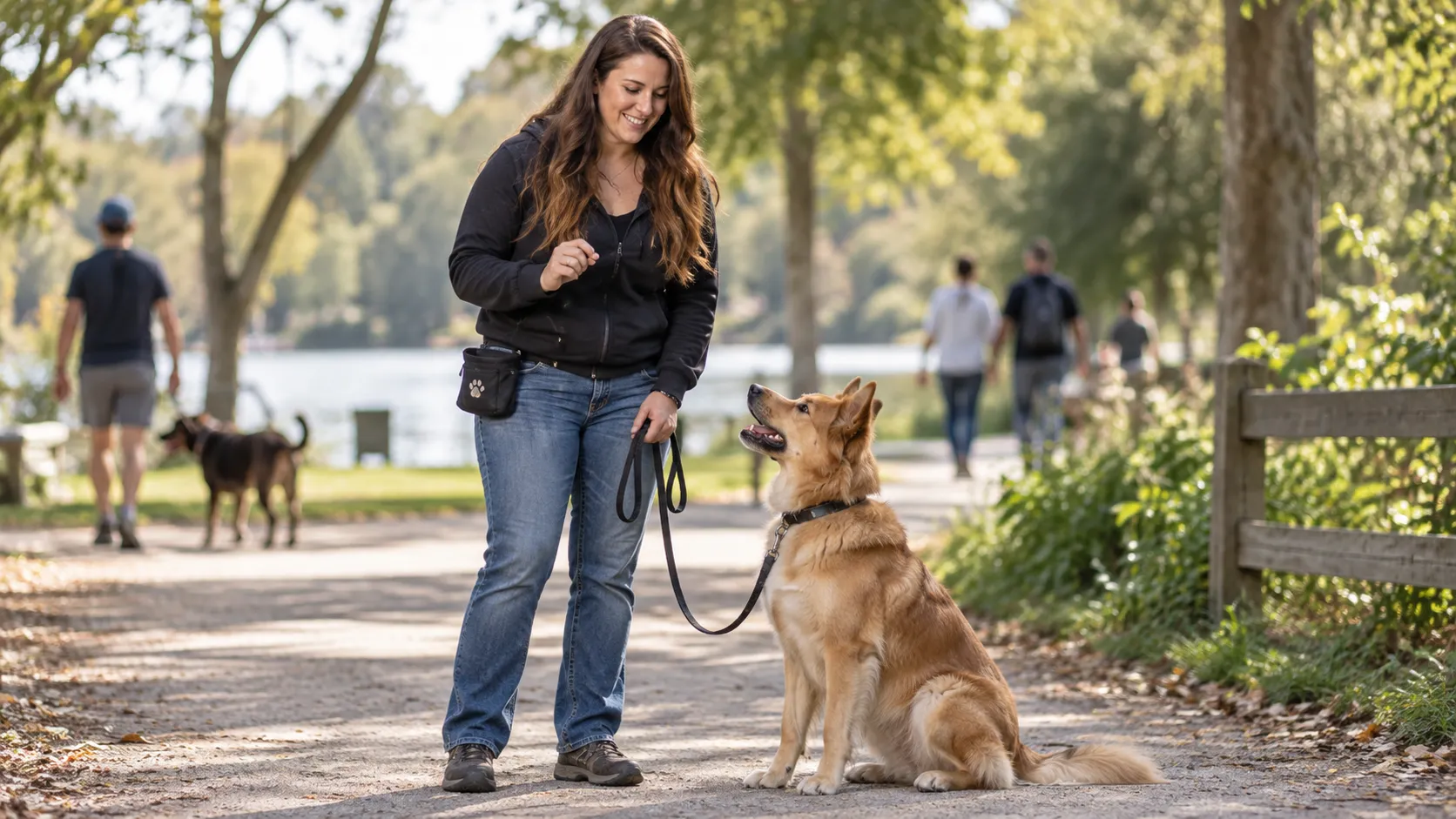
Why Does My Dog Listen at Home but Not Outside?
Inside your home, the environment is familiar and predictable.
Your dog already knows the smells, sounds, furniture, people and routines. There may be very little competing for their attention.
Outside, everything changes.
Your dog may suddenly be surrounded by:
- Other dogs
- People
- Cars and bicycles
- Wildlife
- Interesting smells
- Children playing
- New environments
- Unexpected sounds
- Movement
- Other exciting distractions
From your dog’s perspective, listening to you has suddenly become much harder.
It is similar to learning a new skill in a quiet room and then being expected to perform it perfectly in the middle of a busy event.
The skill may exist, but the difficulty level has changed dramatically.
Dogs Do Not Automatically Generalize Training
One of the most important things for dog owners to understand is that dogs do not always generalize learning the way people expect them to.
If your dog learns “sit” in the kitchen, they may initially understand the behaviour as something that happens in that particular situation.
When you ask for the same behaviour in the backyard, on the sidewalk or near another dog, the context is different.
This is why good dog training gradually introduces new environments and distractions.
A behaviour becomes more reliable when your dog has successfully practised it in many different situations.
Training might progress from:
- Living room
- Different rooms in the house
- Backyard
- Driveway
- Quiet sidewalk
- Neighbourhood walk
- Park at a distance from distractions
- Busier environments
Each step teaches your dog that the cue still matters even when the environment changes.
Distractions Compete for Your Dog’s Attention
When your dog is outside, you are competing with everything happening around them.
A squirrel running across the grass may be more exciting than sitting.
The smell of another dog may be more interesting than looking at you.
An approaching dog may create enough excitement, frustration or concern that your dog struggles to respond to a familiar cue.
This does not necessarily mean your dog is stubborn.
It usually means the environment is currently more difficult than the dog’s level of training can handle.
Your Dog May Understand the Cue, but Not Around Distractions
There is an important difference between a dog knowing a behaviour and performing that behaviour reliably.
A dog may understand “come” perfectly well when standing ten feet away inside the house.
That does not mean the dog is ready to recall away from another dog, wildlife or an exciting smell outside.
Real-world reliability has to be developed gradually.
This is particularly important for skills such as:
- Recall
- Loose-leash walking
- Stay
- Place
- Heel
- Leave it
- Focus around distractions
You May Be Increasing Difficulty Too Quickly
One common training mistake is asking too much too soon.
Imagine your dog can successfully recall from ten feet away in your backyard.
The next step should probably not be asking for the same recall while they are chasing something across a busy park.
Instead, gradually increase one challenge at a time.
You can increase:
- Distance
- Duration
- Distraction
- Environmental difficulty
Trying to increase all of these at once often makes training unnecessarily difficult.
If your dog stops responding, that may be a sign that the current situation is too challenging and you need to make the exercise easier before progressing again.
How to Help Your Dog Listen Outside
Improving outdoor reliability requires more than repeating commands louder.
Instead, make the training process clearer and more achievable for your dog.
1. Start Somewhere Quiet
Do not begin in the most distracting environment available.
Choose a quiet outdoor location where your dog can still notice the environment without becoming completely absorbed by it.
Your backyard, driveway or a quiet section of your neighbourhood can be a good starting point.
2. Practise Skills Your Dog Already Knows
Outdoor training is not the best time to introduce several completely new behaviours.
Begin with simple skills your dog already understands indoors.
For example:
- Name response
- Sit
- Down
- Short stays
- Leash walking
- Recall from a short distance
This makes it easier for your dog to succeed while learning that familiar cues still apply outside.
3. Reward Attention
Before expecting advanced obedience, your dog needs to be able to pay attention to you.
Reward voluntary check-ins and moments when your dog chooses to look back at you rather than becoming completely focused on the environment.
Building engagement can make future training much easier.
4. Create More Distance From Distractions
If your dog cannot respond when another dog is ten feet away, moving closer probably will not improve the situation.
Instead, increase the distance until your dog can notice the distraction while still responding to you.
Once your dog becomes more successful, you can gradually decrease the distance over time.
5. Keep Training Sessions Short
Outside environments can be mentally demanding.
Five focused minutes of successful training may be more productive than thirty minutes of struggling.
Short sessions also make it easier to end training while your dog is still engaged and successful.
6. Stop Repeating Commands
If you repeatedly say:
“Sit… sit… sit… SIT!”
your dog may learn that the first few cues are optional.
Instead, make sure the situation is appropriate for the dog’s current ability before giving the cue.
If your dog cannot respond, reduce the difficulty rather than simply repeating yourself.
Why Does My Dog Ignore Me on Walks?
Walks combine many challenges at the same time.
Your dog is moving through constantly changing surroundings while experiencing new smells, people, dogs, sounds and movement.
If leash skills have only been practised indoors, your dog may not yet have enough experience to perform those same skills successfully on a neighbourhood walk.
Start by practising in easier environments and gradually build toward more challenging walks.
If your dog also barks, lunges or becomes highly aroused around other dogs or people, you may be dealing with reactivity rather than simply poor attention.
Our article Reactive Dog vs Aggressive Dog: What’s the Difference? explains how reactive behaviour can differ from aggression and when individualized training may be appropriate.
Why Recall Often Fails Outside
Recall is one of the clearest examples of the difference between knowing a cue and having a reliable behaviour.
Inside the house, coming when called may be easy because there are few competing options.
Outside, your dog may be choosing between coming back to you and continuing to investigate an interesting smell, another dog or wildlife.
A reliable recall requires a strong reinforcement history and progressive practice around distractions.
Until your dog’s recall is genuinely reliable, use an appropriate leash or long line in open environments rather than assuming the dog will respond every time.
Is My Dog Being Stubborn?
Owners often describe dogs who do not respond outside as stubborn.
But labelling the behaviour as stubborn does not tell us why it is happening.
Before assuming your dog is deliberately ignoring you, consider:
- Is the environment too distracting?
- Has the behaviour been practised here before?
- Does your dog clearly understand the cue?
- Is the dog too excited or overwhelmed to respond?
- Have you increased the difficulty too quickly?
- Has responding to you been consistently worthwhile?
Answering these questions usually gives you much more useful information than simply deciding the dog is being difficult.
When Outdoor Distractions Become Reactivity
Some dogs are not simply distracted outside.
They may bark, lunge, pull intensely, freeze or become unable to focus when certain triggers appear.
When this happens, the issue may involve reactivity, fear, frustration or another behavioural response.
These dogs often benefit from an individualized training plan rather than simply increasing obedience exercises in a busy environment.
The Crunchy Canine offers private in-home dog training for owners who need help with real-world behaviour challenges, including leash skills, recall, reactivity, household manners and reliability around distractions.
Private Dog Training Can Help Build Real-World Reliability
One advantage of private training is that training can happen where your problems actually occur.
Your dog may behave perfectly inside a training facility but struggle on your own street.
Or your biggest concern may happen when visitors enter your home, when another dog walks past your property or when you take your dog through a particular neighbourhood environment.
Private dog training allows the training plan to focus on your dog, your environment and the specific situations that are creating difficulty.
Instead of simply demonstrating what your dog can do in a controlled setting, the goal is to help you build skills that can transfer into everyday life.
Contact The Crunchy Canine to discuss your dog’s training needs.
Dog Training Across Our Ontario Service Areas
The Crunchy Canine works with dog owners throughout several Southern Ontario communities.
Learn more about training options in your area:
- Dog Training in Hamilton
- Dog Training in Burlington
- Dog Training in Oakville
- Dog Training in Norfolk County
- Dog Training in Simcoe
If your community is not listed, contact us with your location to ask about service availability.
Frequently Asked Questions
Why does my dog listen inside but ignore me outside?
Outside environments usually contain far more distractions than your home. Your dog may understand the behaviour but may not yet have practised it enough around smells, people, other dogs, movement and other distractions.
Does my dog forget their training when we go outside?
Usually not. A dog may know a behaviour in one environment without being able to perform it reliably everywhere. Dogs need practice in different locations and gradually increasing levels of distraction.
Should I repeat a command if my dog does not listen?
Repeatedly saying the same cue is usually less useful than determining why the dog cannot respond. Reduce the difficulty, create more distance from distractions and practise at a level where your dog can succeed.
How can I get my dog to pay attention to me outside?
Begin in a relatively quiet outdoor environment. Reward your dog for checking in with you, practise simple familiar behaviours and gradually increase distractions as your dog becomes more successful.
Why does my dog’s recall work at home but not at the park?
The park contains many more competing distractions. Recall needs to be practised gradually with increasing distance and distraction before it can become reliable in more challenging environments.
Is my dog stubborn if they do not listen outside?
Not necessarily. Difficulty responding outside often means the environment is more challenging than the dog’s current level of training. Look at distraction level, previous practice and your dog’s emotional state before assuming stubbornness.
When should I get professional dog training help?
Consider professional help when your dog’s behaviour is interfering with normal walks, outings or everyday life, when you are struggling to make progress on your own, or when barking, lunging, fear or reactivity makes training difficult.
Build Training That Works Beyond the Living Room
If your dog listens at home but not outside, it does not mean your training has failed.
It usually means the behaviour needs more practice in different environments and around carefully controlled distractions.
Start with situations where your dog can succeed, increase difficulty gradually and focus on building reliable communication rather than expecting indoor skills to work everywhere immediately.
Real-world reliability takes practice, but the result is a dog who can respond to you when it actually matters.
If you want help developing reliable behaviour at home, on walks and around everyday distractions, contact The Crunchy Canine to discuss private dog training.