
Reactive Dog vs Aggressive Dog: What’s the Difference?
Many dog owners use the words reactive and aggressive interchangeably, but they do not always mean the same thing.
A dog that barks, lunges, growls or pulls toward another dog during a walk may look aggressive, but the behaviour could actually be a reaction caused by fear, frustration, excitement or feeling overwhelmed.
Understanding the difference between a reactive dog and an aggressive dog is an important first step toward choosing the right training approach.
At The Crunchy Canine, we help owners understand why their dogs behave the way they do and develop practical training strategies that improve communication, confidence and reliability in everyday situations.
Contact The Crunchy Canine to discuss your dog’s behaviour and training needs.
What Is a Reactive Dog?
A reactive dog is a dog that has an exaggerated response to a specific trigger.
The trigger could be:
- Another dog
- Strangers
- Children
- Bicycles
- Cars
- New environments
- Visitors entering the home
- Unexpected sounds
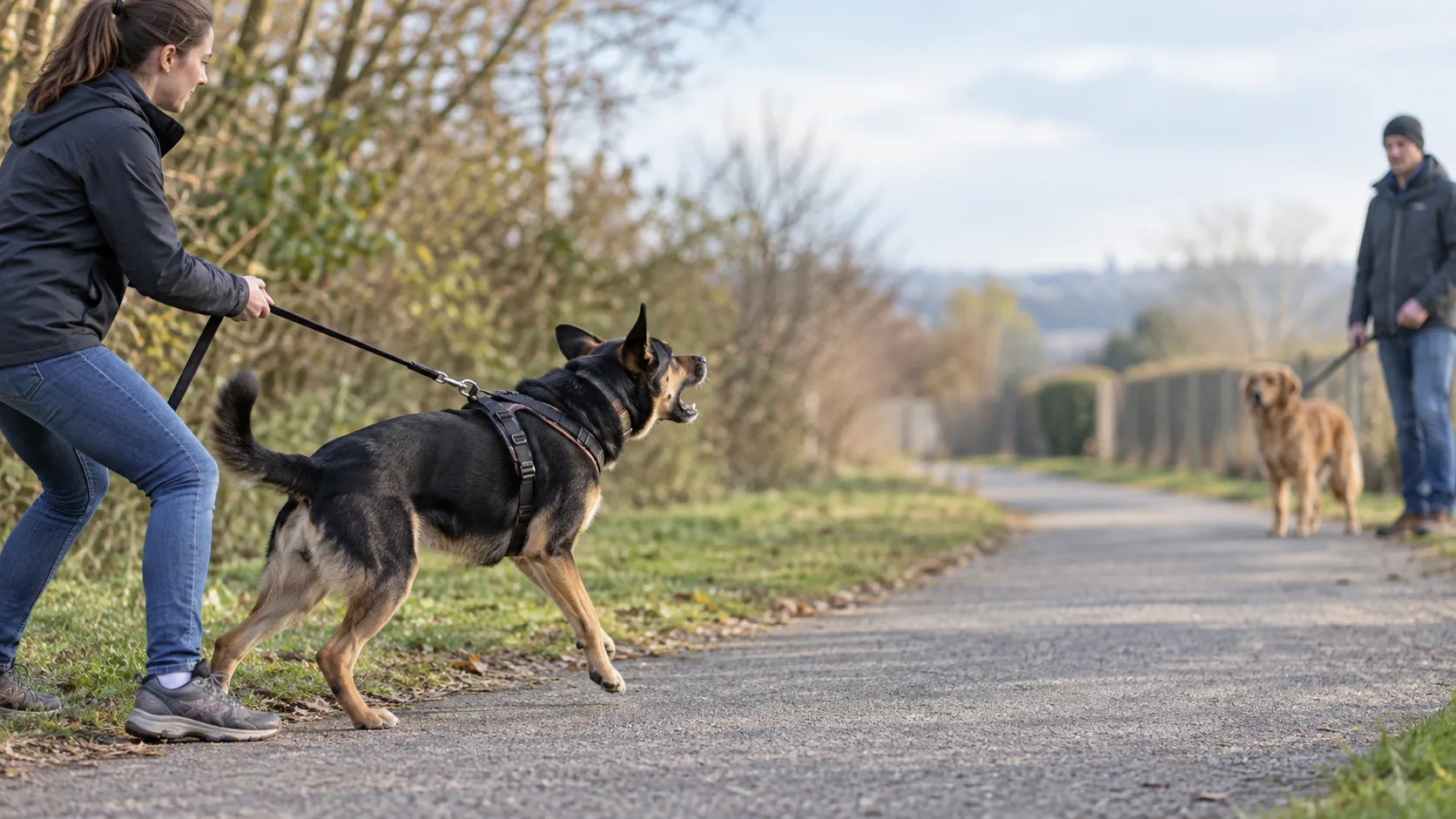
When a reactive dog sees a trigger, they may bark, growl, whine, pull on the leash, freeze, hide or become overly excited.
The behaviour is often connected to an emotional response. A dog may be scared, frustrated, unsure, overly excited or unable to cope with the situation.
For example, a dog that barks and lunges at another dog during a walk may not want to harm the other dog. The dog may actually be uncomfortable, frustrated because they cannot greet the dog, or unsure how to respond.
What Is an Aggressive Dog?
Aggression describes behaviour intended to create distance, control an interaction or cause harm.
Aggressive behaviour can include:
- Biting or attempting to bite
- Repeated threatening behaviour
- Guarding resources intensely
- Serious attacks
- Escalating behaviour despite attempts to create distance
However, aggression is not a simple label that can be applied after seeing one behaviour.
A dog that growls is communicating. A growl does not automatically mean a dog is aggressive. It is information that tells us the dog is uncomfortable, stressed or attempting to communicate a boundary.
Understanding the reason behind the behaviour is essential before deciding what type of training approach is appropriate.
Reactive Dog vs Aggressive Dog: Key Differences
| Reactive Dog | Aggressive Dog |
|---|---|
| Often reacts to specific triggers | May display behaviour intended to threaten or harm |
| Behaviour may come from fear, frustration or excitement | Behaviour may involve serious safety concerns |
| May bark, pull, lunge or avoid | May bite, attack or repeatedly threaten |
| Often improves with behaviour training and management | Requires careful assessment and a structured safety-focused approach |
| Usually has identifiable triggers | May have more complex behavioural patterns |
Why Do Dogs Become Reactive?
Dogs can become reactive for many different reasons.
Common factors include:
- Lack of appropriate social experiences
- Fear or uncertainty
- Frustrating experiences
- Past negative experiences
- Genetics and temperament
- Overexcitement
- Lack of impulse control
- Learning that a behaviour creates distance from something uncomfortable
For example, if a dog barks at another dog and the other dog eventually walks away, the dog may learn that barking works.
Over time, this response can become stronger unless the dog learns a better way to handle the situation.
Signs Your Dog May Be Reactive
Your dog may be showing reactive behaviour if they:
- Bark or lunge when seeing other dogs
- Pull intensely during walks
- Become difficult to control around distractions
- Cannot focus when certain triggers appear
- Become overly excited when meeting people
- React strongly at windows or fences
- Need significant distance from certain triggers
These behaviours can be stressful for both dogs and owners, but they are common training challenges that can often be improved with the right approach.
Can a Reactive Dog Become Better?
Yes, many reactive dogs can make significant progress with appropriate training.
The goal is not always to make a dog love every person, dog or situation they encounter.
The goal is to help the dog:
- Feel more comfortable
- Make better choices
- Respond to owner guidance
- Develop stronger impulse control
- Handle everyday situations more successfully
This requires consistency, clear communication and a training plan designed around the individual dog.
When Should You Consider Professional Dog Training?
Many owners wait until behaviour becomes overwhelming before seeking help.
Professional training can be useful when:
- Your dog is difficult to control on walks
- You avoid certain places because of your dog’s behaviour
- Your dog reacts strongly around visitors
- You feel unsure how to respond
- Your dog’s behaviour is affecting daily life
Every dog is different, which is why understanding the cause of the behaviour is more important than simply trying to stop the visible reaction.
Private Training for Reactive Dogs
Reactive behaviour often requires an individualized approach.
A dog that struggles around other dogs may need a different training plan from a dog that reacts to strangers, noises or handling.
The Crunchy Canine provides private dog training designed around your dog’s specific needs and real-life challenges.
Private training allows us to focus on the situations that matter most, whether that involves neighbourhood walks, home behaviour, visitors, distractions or confidence building.
Contact us to discuss private training options for your dog.
Reactive Dog Training in Ontario
The Crunchy Canine works with dog owners throughout Southern Ontario, including:
If your dog struggles with barking, lunging, fear-based behaviour or difficulty coping with everyday situations, professional guidance can help you understand what your dog is communicating and build better responses.
Frequently Asked Questions
Is a reactive dog dangerous?
Not necessarily. Many reactive dogs are reacting because they are uncomfortable, fearful, frustrated or overwhelmed. Understanding the reason behind the behaviour is important before making assumptions.
Does a reactive dog mean my dog is aggressive?
No. Reactive behaviour and aggression are not the same thing. A dog can react strongly to a trigger without intending to cause harm.
Can reactive dogs be trained?
Yes. Many reactive dogs improve with consistent training, appropriate management and a plan designed around their individual behaviour.
Should a reactive dog attend group classes?
It depends on the individual dog. Some reactive dogs benefit from private training first before participating in group environments.
How do I know if my dog needs professional help?
If your dog’s behaviour is affecting your daily life, limiting activities or creating stress for you or your dog, professional guidance can help you choose the right next steps.
A reactive dog is not automatically an aggressive dog.
Understanding the difference allows owners to respond with better information instead of frustration or fear.
With patience, consistency and the right training approach, many dogs can learn better ways to respond to the world around them.
If you are struggling with your dog’s behaviour, contact The Crunchy Canine and let us help you understand the best training option for your dog.