Dec 22, 2016 | Puppy Training
Are you expecting a baby and wondering how to prepare your dog for the new arrival?
Many expecting parents ask how to properly introduce their dog to a new baby once the baby comes home. In my opinion, it is not as simple as one perfect introduction. There are several important things you should begin working on long before the baby arrives.
When it comes to dogs and babies, preparation matters. The more structure, training, and boundaries your dog has before the baby comes home, the easier the transition will usually be for everyone.
Preparing Your Dog Before the Baby Arrives
Many people plan to bring home a baby blanket for the dog to smell before the baby arrives. Others play baby crying sounds to help the dog get used to the noise.
I do not think either of those things will hurt, but I also do not believe they guarantee that the transition will go smoothly. Of course, when working with animals, there is never a guarantee with anything.
Instead, I recommend focusing on practical training skills and clear household expectations before the baby comes home.
5 Things to Teach Your Dog Before Bringing Home a Baby
The following skills are useful for all dogs, whether or not there is a baby on the way. However, they become even more important when children are going to be involved.
Start as early as possible. The sooner you begin, the easier it will be to enforce these rules once the baby arrives.
1. Teach Your Dog to Walk Nicely on Leash
Even with a new baby at home, your dog will still need exercise, structure, and mental stimulation.
If your dog is dragging you down the street, you will be much less likely to walk them, especially when you also have a stroller. Many behaviour problems can become worse when dogs do not get enough exercise or mental engagement.
A proper loose leash walk can make a huge difference, especially for dogs with high energy. It is also a good idea to practice walking with the stroller before the baby arrives so your dog is already familiar with the setup.
2. Stop Jumping Immediately
If your dog jumps on people, this behaviour needs to be addressed immediately.
It does not matter if your dog is big or small, friendly or not. There should be zero jumping on people, especially when a baby will be in the home.
This also includes jumping on people when they are sitting on the couch. I am not opposed to dogs being on furniture if they are polite and respectful. However, dogs still need boundaries and should respect personal space.
If your dog jumps all over you, jumps on guests, or jumps on people when they sit down, now is the time to stop that behaviour.
3. Address Resource Guarding With a Professional Trainer
If your dog guards any resources, you should work with a trainer who has experience with this issue.
The most common type of resource guarding is guarding food. Your dog should learn not to stress when people are near the food bowl.
If your dog guards furniture, such as growling or biting when you go near them on the couch or ask them to get off, then furniture privileges should be removed.
For safety, high-value bones or treats should only be given in a safe space, such as a crate or separate room.
4. Set and Enforce Rules and Boundaries
Before the baby arrives, decide what household rules you want your dog to follow.
For example, if you do not want your dog upstairs or in the baby’s room, set that rule now and enforce it consistently.
Whatever rules you choose, consistency is very important. Dogs do best when expectations are clear and predictable.
5. Teach the Place Command
The place command is one of the most powerful commands you can teach your dog.
Place means your dog goes to a specific object, usually a dog bed, and keeps all four feet on it. But place is more than just a position. It is also a state of mind.
Your dog should learn that place means calm, settled, and out of the way.
This command can be incredibly helpful when you are feeding the baby, welcoming guests, cleaning, or simply needing your dog to relax. It may feel frustrating before it becomes easy, but it is absolutely worth it in the long run.
Introducing Your Dog to the Baby
Once it is time for the baby to come home, the introduction should be calm, quiet, and controlled.
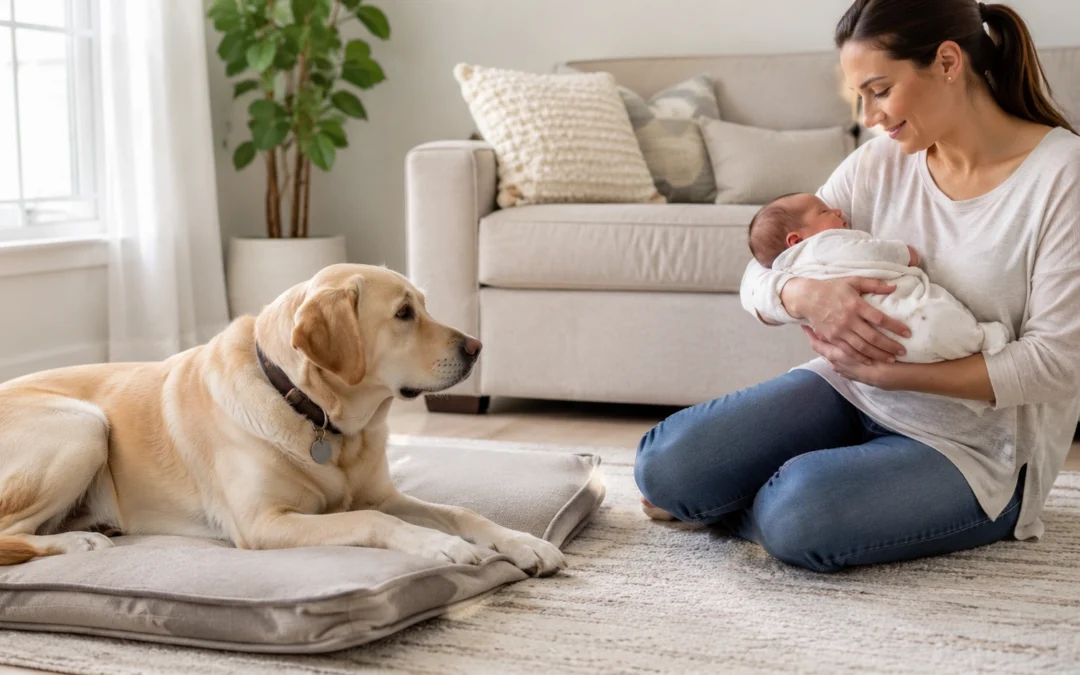
I suggest having your dog on leash and on place when the baby arrives home. Keep your dog there until everyone is settled and the initial excitement of coming home has passed.
Only once things are calm should you release your dog from place.
Do Not Force the Introduction
Try your best not to be nervous or anxious, as your dog can feed off your emotions.
Do not force your dog to sniff the baby. Do not bend down and push the baby toward the dog, and do not place the car seat on the floor for the dog to investigate.
The first introduction should be calm and low-pressure. You can sit down with the baby while your dog remains on the floor. The less of a big deal you make it, the better.
If your dog tries to jump up or becomes too excited, the leash allows you to guide them into a better decision. You can also send your dog back to place if needed.
Allow Short and Calm Sniffing Over Time
As your dog shows that they can remain calm around the baby, you can allow brief sniffing.
Keep it short and sweet. If your dog becomes overly excited, stop the interaction and put them back on place to calm down.
This process may take some time. That is okay. Going slowly is usually the best way to help your dog adjust successfully.
Do Not Forget Your Dog’s Needs After the Baby Arrives
After the baby comes home, it is important to continue meeting your dog’s needs.
A new baby can be overwhelming, but it is not a reason to ignore your dog. Simply putting your dog outside in the yard is not enough exercise or stimulation.
If your dog does not receive enough attention, structure, exercise, or mental stimulation, you may begin to see unwanted behaviours appear.
In most cases, dogs still need two walks per day and some playtime, even when life gets busy. There are very few exceptions to this rule.
Always Supervise Dogs and Babies
Once your dog and baby have been introduced and everything seems to be going well, supervision is still required.
Even the gentlest dog has the ability to make a bad decision. For that reason, you should never leave a dog and baby alone together.
There are no exceptions to this rule.
Need Help Before Your Baby Comes Home?
If you need help with training before your baby arrives, please contact us as soon as possible.
Giving yourself enough time to train will help set both you and your dog up for success. Whether your dog needs help with leash manners, jumping, boundaries, place command, or general behaviour, training before the baby comes home can make the transition much easier.
Our private dog training programs can help you prepare your dog for this important life change.
Book a Consultation
Happy Training!
Katherine
FAQ:
How should I prepare my dog before bringing home a baby?
Start by teaching important skills such as loose leash walking, no jumping, clear boundaries, and the place command. It is also important to address resource guarding with a qualified trainer before the baby arrives.
Should I let my dog smell a baby blanket before the baby comes home?
You can let your dog smell a baby blanket, but it should not be the only preparation you do. Practical training, structure, and boundaries are much more important for long-term success.
How should I introduce my dog to my newborn baby?
Keep the introduction calm and quiet. Have your dog on leash and on place when the baby comes home. Do not force sniffing or interaction. Allow short, calm introductions over time.
Can I leave my dog alone with my baby?
No. Dogs and babies should always be supervised. Even a gentle dog can make a poor decision, so a dog and baby should never be left alone together.
Why is the place command helpful with a new baby?
The place command gives your dog a clear job and a calm space to settle. It is especially helpful during feeding, visitors, busy moments, or times when your dog needs to be out of the way.
Learn More:
Using Food for Dog Training the Right Way
Teaching Impulse Control through Play
6 Tips for Teaching a Solid Recall (coming when called)
Aug 23, 2016 | Puppy Training
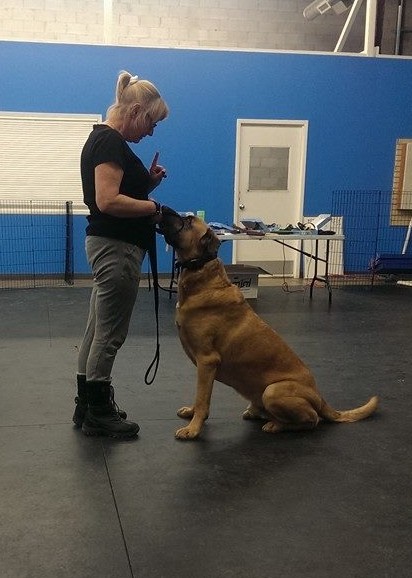
Bear has crazy high ball drive. He would literally play fetch all day if he could. It is almost obsessive, really.
For dogs like Bear, play is not just play. It can also become an excellent opportunity to teach focus, patience, and better decision-making. That is why we are working on impulse control through play using the controlled retrieve.
Teaching Impulse Control Through Play
Many high-drive dogs love toys, balls, tug, or fetch so much that they struggle to think clearly when the game starts. They may bark, jump, grab, chase too early, or become overly excited before you even throw the ball.
Instead of removing play completely, we can use that motivation in a more structured way. Teaching impulse control through play helps the dog learn that calm behaviour, listening, and waiting are part of the game.
What Is a Controlled Retrieve?
A controlled retrieve is a structured way to play fetch. The dog does not simply chase the ball whenever they want. Instead, the dog learns to wait, listen, retrieve when released, return the item, and stay engaged with the handler.
This teaches the dog that access to the ball comes through self-control. For a dog with strong ball drive, the ball becomes a powerful reward, but the dog must use their brain before getting it.
Why High-Drive Dogs Need Impulse Control
High-drive dogs often have plenty of energy and enthusiasm, but they may need help learning how to control that energy. Without structure, excitement can quickly turn into frustration, jumping, barking, grabbing, or ignoring commands.
Impulse control training helps dogs learn how to pause, think, and make better choices even when something exciting is happening.
This type of training can be especially helpful for dogs who struggle with:
- Obsessive ball or toy drive
- Jumping or barking before play starts
- Grabbing toys from the hand
- Ignoring commands when excited
- Difficulty calming down after play
- Over-arousal around toys, people, or other dogs
Using Play as a Training Tool
Play should be fun, but it should also have rules. When dogs understand the rules of the game, play becomes safer, more productive, and more rewarding for both the dog and the handler.
For Bear, the goal is not to take away his love of fetch. The goal is to teach him how to control himself around something he loves.
When done properly, controlled play can build better obedience, stronger focus, and a calmer state of mind.
More Training Options for High-Drive Dogs
If your dog has a lot of energy, strong toy drive, or trouble settling, structured training can help teach them how to use that energy in a better way.
Our dog training programs can help you find the right training option for your dog’s needs.
For dogs who need one-on-one support with impulse control, over-arousal, jumping, or listening around distractions, our Private Training programs are a great place to start.
If your dog would benefit from learning around other dogs and people, our Group Classes can help build better focus in a structured environment.
High-drive dogs may also enjoy healthy outlets such as Agility or Scent Detection, where they can use their energy and brain in a productive way.
For dogs who need structured activity during the day, our Day Camp may also be a helpful option.
Teaching impulse control through play is a great way to help high-drive dogs learn patience without removing the things they love.
For Bear, the ball is highly rewarding. By using the controlled retrieve, we can turn that excitement into a training opportunity and help him build better focus, self-control, and listening skills.
If you need help teaching your dog impulse control, structured play, or better manners, contact us today to learn how we can help.
FAQ:
What does impulse control mean in dog training?
Impulse control means teaching a dog to pause, think, and make better choices instead of immediately reacting to excitement, food, toys, people, or other distractions.
Can play help teach impulse control?
Yes. Play can be a very effective way to teach impulse control because the dog is motivated and engaged. Structured games teach the dog that calm behaviour and listening are part of earning the reward.
What is a controlled retrieve?
A controlled retrieve is a structured version of fetch where the dog waits, listens, retrieves when released, returns the item, and stays connected with the handler.
Is fetch bad for high-drive dogs?
Fetch is not always bad, but it can become overwhelming or obsessive for some dogs if there are no rules. Adding structure can make fetch more useful and help teach better self-control.
Can private training help with a high-drive dog?
Yes. Private training can help address impulse control, over-arousal, toy obsession, jumping, leash manners, and listening around distractions.
Jul 25, 2016 | Puppy Training
Great question! Many dog owners wonder, how much exercise does my dog need? The answer depends on your dog’s age, breed, health, size, energy level, and individual personality.
Exercise is one of the first things I ask about when meeting a new client. Whether the concern is house training, leash manners, excessive barking, jumping, or behaviour modification, exercise almost always matters.
In many cases, dogs are not getting enough physical activity or mental stimulation. Sometimes, they are getting no real exercise at all. Unless your dog has a medical issue that prevents exercise, there is a good chance their activity level could be improved.
More appropriate exercise can help create a happier, healthier, and more well-behaved dog. It can also be good for your own health too.
Exercise Is Important, But Balance Matters
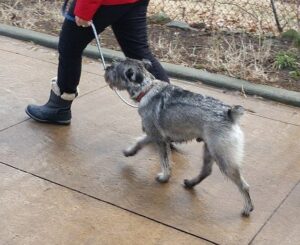 While exercise is very important, there still needs to be balance.
Some dogs can get plenty of exercise and still act hyper, restless, or wild in the house. In those cases, the answer is not always more exercise. The dog may also need to learn how to relax after their needs have been met.
Balanced training is about creating balance as a whole, not just in training methods. Dogs need physical exercise, mental stimulation, structure, and the ability to settle.
For now, let’s focus on the exercise side of things.
How Do You Know How Much Exercise Your Dog Needs?
There are several important factors to consider when figuring out how much exercise your dog needs.
The most obvious factors include:
However, many people forget to consider:
- Breed
- Energy level
- The individual dog in front of them
If you already have your dog, then you need to work with the dog you have and take responsibility for meeting that dog’s needs. If you are still choosing a dog, do your homework first and make sure you are picking a dog that fits your lifestyle.
The Minimum Exercise Most Dogs Need
Let’s start with a basic foundation.
For most healthy dogs, the bare minimum should be two walks per day. Yes, two walks per day.
A good starting point is two 20-minute walks each day. From there, you can adjust based on your dog’s breed, age, health, and energy level.
If you live alone, this means finding at least 40 minutes in your day to walk your dog. If other people live in the home, walking duties can be shared.
Finding 20 minutes at a time to walk your dog is realistic for most people, and both you and your dog can benefit from it.
Breed Makes a Big Difference
Some breeds naturally need more exercise than others.
For example, a Jack Russell Terrier and an Old English Bulldog may both be smaller dogs, but they usually have very different energy levels.
The same is true with large breeds. An English Mastiff and a German Shepherd are both large dogs, but their exercise needs are often very different.
If you have a high-energy breed, two short walks may not be enough. Many high-energy dogs may need at least two 30 to 45-minute walks per day, along with other forms of activity or mental stimulation.
Your Individual Dog Matters Too
Breed can give you a general idea, but your individual dog matters just as much.
You can have a lower-energy Jack Russell Terrier or German Shepherd, although they may be the exception rather than the rule. You can also have a breed that is usually lower energy but still end up with a dog who needs much more activity.
For example, a lower-energy German Shepherd may do well with two 30-minute walks per day. A high-energy German Shepherd may need much more.
Take an honest look at your dog’s actual energy level and adjust from there.
What Counts as Exercise for Dogs?
Walking is one of the best foundations for dog exercise. A structured walk can provide physical movement, mental stimulation, and opportunities to practice manners.
However, walking is not the only way to exercise your dog.
Other helpful forms of exercise and enrichment include:
- Playing fetch
- Playing tug with rules
- Off-leash hiking or exploring in safe areas, only if your dog is trained for it
- Swimming, when safe and appropriate
- Puzzle toys and busy work
- Training games
- Structured play
One thing that does not count as proper exercise is simply putting your dog in the backyard. Backyard time can be fine, but it does not replace walks, training, play, or mental stimulation.
Signs Your Dog May Need More Exercise
If you are unsure whether your dog needs more exercise, look at their behaviour.
Your dog may need more physical activity or mental stimulation if they:
- Constantly look for something to do
- Bark excessively for no clear reason
- Demand attention all the time
- Try to run out the door whenever they get the chance
- Become overly excited or hard to control when you do take them out
- Are overweight
- Dig in the yard
- Act out on days they do not get walked or exercised
- Run around the house endlessly and drive you crazy
If you said yes to any of these, your dog may benefit from more exercise, more structure, or both.
Exercise may not fix every training problem, but it is a very good place to start.
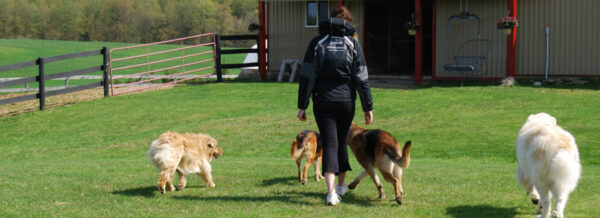
Training Works Better When Your Dog’s Needs Are Met
If you are struggling with your dog’s behaviour, the first step is often making sure your dog is fulfilled mentally and physically.
Once your dog’s basic exercise and stimulation needs are being met, training becomes much more effective.
Our dog training programs can help you choose the right training path for your dog’s needs, whether you are dealing with puppy manners, leash walking, behaviour issues, or impulse control.
If your dog needs one-on-one support with behaviour, leash manners, overexcitement, or structure at home, our Private Training programs may be the best fit.
For dogs who would benefit from learning around other dogs and people, our Group Classes can help build focus, obedience, and confidence around distractions.
If your dog has extra energy and enjoys active learning, Agility can be a fun outlet. For dogs who need mental stimulation and love using their nose, Scent Detection can be a great option.
For dogs who need structured activity during the day, our Day Camp may also help provide exercise, enrichment, and routine.
Book a Consultation
So, how much exercise does your dog need?
For most healthy dogs, start with two walks per day and adjust based on your dog’s breed, age, health, energy level, and individual needs.
Remember, exercise is not just about making your dog tired. It is about creating a healthier, more fulfilled dog who is better able to learn, relax, and behave well in daily life.
If you are struggling with your dog and want help with training, start by fulfilling your dog with mental and physical exercise. Then, training can be much more successful.
Contact us today if you would like help creating a better training and exercise plan for your dog.
FAQ:
How much exercise does my dog need every day?
Most healthy dogs should start with at least two walks per day. A good starting point is two 20-minute walks, then you can adjust based on your dog’s breed, age, health, and energy level.
Do high-energy dogs need more than two walks a day?
Many high-energy dogs need longer walks, extra play, structured training, and mental stimulation. Some may need two 30 to 45-minute walks per day or more depending on the individual dog.
Does backyard time count as exercise?
No, backyard time does not replace proper exercise. Dogs still need walks, structured play, training, and mental stimulation to stay fulfilled.
Can lack of exercise cause behaviour problems?
Yes. Lack of exercise and mental stimulation can contribute to barking, digging, door bolting, demanding behaviour, restlessness, and other unwanted behaviours.
What if my dog gets lots of exercise but is still hyper?
If your dog gets enough exercise but is still hyper at home, they may need help learning how to relax. Training, structure, and calm behaviour work are important parts of creating balance.
Jun 26, 2016 | Puppy Training
Have a new puppy and struggling with accidents in the house? You are not alone. Potty training your puppy takes consistency, patience, and a clear routine.
The good news is that puppy potty training does not need to be complicated. If you follow a simple plan and stay proactive, you can help your puppy understand where they should go and reduce accidents inside the home.
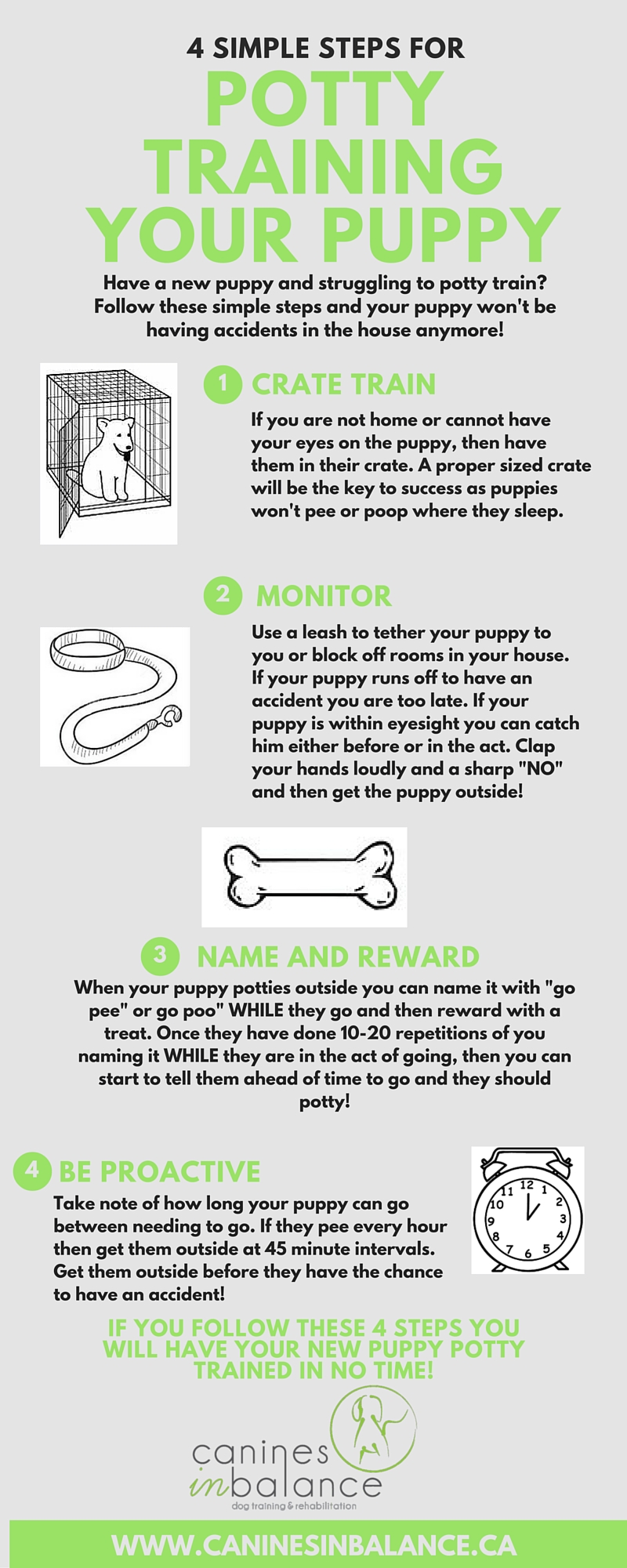
Here are 4 simple steps for potty training your puppy.
4 Simple Steps for Potty Training Your Puppy
Successful potty training comes down to management, timing, rewards, and prevention. Puppies do not automatically know where they should pee or poop, so it is our job to guide them and set them up for success.
1. Crate Train Your Puppy
If you are not home, or if you cannot keep your eyes on your puppy, your puppy should be safely in their crate.
A properly sized crate is one of the keys to potty training success. Most puppies do not want to pee or poop where they sleep, so crate training can help teach bladder control and prevent accidents when you cannot directly supervise.
The crate should be large enough for your puppy to stand up, turn around, and lie down comfortably, but not so large that they can potty in one corner and sleep in another.
2. Monitor Your Puppy Closely
When your puppy is out of the crate, they should be supervised. You can use a leash to tether your puppy to you, or you can block off rooms in your house so they cannot sneak away.
If your puppy runs off and has an accident, you are already too late. When your puppy stays within eyesight, you have a much better chance of catching them before or during the act.
If you catch your puppy about to have an accident, interrupt them and get them outside right away. The goal is to help your puppy learn that outside is the right place to go.
3. Name and Reward the Behaviour
When your puppy potties outside, name the behaviour while they are doing it. You can say something simple like “go pee” or “go poo” while your puppy is actively going.
As soon as they finish, reward them with a treat, praise, or both.
After about 10 to 20 repetitions of naming the behaviour while your puppy is in the act, you can start saying the cue before they go. Over time, your puppy can begin to understand what the cue means.
4. Be Proactive
Potty training works best when you get your puppy outside before they have the chance to make a mistake.
Pay attention to how long your puppy can usually go between potty breaks. For example, if your puppy tends to pee every hour, take them outside at 45-minute intervals.
Do not wait until your puppy is already having an accident. Get them outside before the accident happens.
Book a Consultation
Why Puppy Potty Training Requires Consistency
Puppies learn through repetition. The more often your puppy successfully goes outside and gets rewarded, the faster they can understand the routine.
On the other hand, if your puppy is allowed to wander freely and have accidents inside, potty training can take much longer.
Consistency is what helps your puppy learn the rules clearly.
Common Puppy Potty Training Mistakes
If potty training is not going well, one of these common mistakes may be part of the problem:
- Giving the puppy too much freedom too soon
- Not using a properly sized crate
- Waiting too long between potty breaks
- Not rewarding immediately after outdoor potty success
- Letting the puppy sneak away out of sight
- Expecting the puppy to understand without enough repetition
The key is to manage your puppy carefully and make the right behaviour easy to repeat.
Need Help With Puppy Training?
Potty training is one of the first important skills your puppy needs to learn, but it is only one part of raising a well-behaved dog.
If you need help with house training, crate training, biting, jumping, leash manners, or basic obedience, our dog training programs can help you choose the right training option.
For puppies who need one-on-one support, our Private Training programs can help create a plan that fits your puppy and your home.
If your puppy is ready to learn around other dogs and people, our Group Classes can help build confidence, focus, and better manners in a structured environment.
For dogs who need structured activity and routine during the day, our Day Camp may also be a helpful option.
Book a Consultation
If you follow these 4 steps, you can make potty training much easier for both you and your puppy.
Crate train, monitor closely, name and reward outdoor potty breaks, and be proactive with your schedule. The more consistent you are, the faster your puppy can learn.
Contact us today if you need help with potty training, crate training, or building better puppy habits from the start.
FAQ:
How do I start potty training my puppy?
Start by using a properly sized crate, supervising your puppy closely, taking them outside often, and rewarding them immediately when they potty outside.
How often should I take my puppy outside to potty?
Young puppies need frequent potty breaks. Watch your puppy’s pattern. If they usually pee every hour, take them out before that, such as every 45 minutes.
Should I crate train my puppy for potty training?
Yes. Crate training can be very helpful for potty training because most puppies do not want to pee or poop where they sleep. The crate must be properly sized and used correctly.
What should I do if my puppy has an accident inside?
If you catch your puppy before or during the accident, interrupt them and take them outside immediately. If you find the accident after it happened, clean it properly and focus on better supervision next time.
How long does puppy potty training take?
Every puppy is different. Potty training depends on age, consistency, routine, supervision, crate training, and how often the puppy is successfully rewarded for going outside.
Jun 15, 2016 | Puppy Training
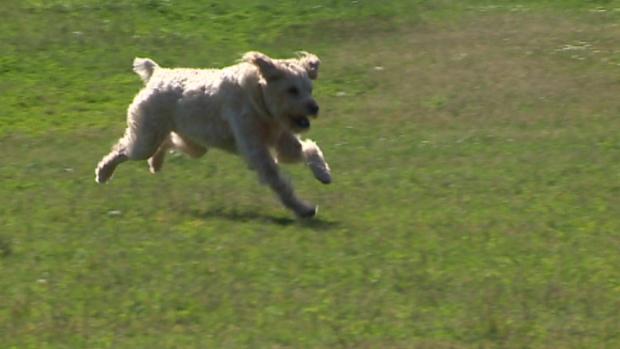
We have all been there: walking our dog, minding our own business, when suddenly an off-leash dog comes running straight toward us.
Somewhere in the distance, the owner calls out, “Don’t worry, he’s friendly!”
But here is the problem: you do not know that dog. Your dog does not know that dog. And even if the other dog is friendly, that does not mean the interaction is safe, polite, or appropriate.
 What to Do If an Off-Leash Dog Runs Up to Your Dog
If an off-leash dog runs up to your dog while you are walking, your job is to advocate for your dog and prevent an unsafe face-to-face interaction whenever possible.
Too often, people allow the rushing dog to approach and simply hope for the best. However, hoping for the best is not a training plan, and it is not always safe.
Why Off-Leash Dogs Running Up Can Be a Problem
A dog running directly toward another dog can be very rude in dog language. Even if the dog is social, the approach may be too intense, too fast, or too stressful for the dog on leash.
Leashed dogs can also feel trapped. They may not have the freedom to move away naturally, which can create tension, fear, frustration, or defensive behaviour.
This is why on-leash walks are not the best place for random dog-to-dog socialization.
What Are Your Options?
When an off-leash dog runs toward you and your dog, many people instinctively choose one of these options:
- Allow the dog to rush up and hope everything goes well
- Pick up their dog if the dog is small enough
- Run away and hope the dog loses interest
- Advocate for their dog and prevent the strange dog from getting face to face with them
In most situations, the safest choice is to advocate for your dog.
Advocate for Your Dog
As your dog’s person, you need to protect their space.
If you do not know the dog approaching, assume that the interaction may not be safe, even if the owner says the dog is friendly. Your responsibility is to your dog, not to the feelings of the other owner.
The other person may be offended. That can happen. But your priority should be preventing a stressful or dangerous situation before it turns into a dog fight.
How to Create Space From an Approaching Dog
If an off-leash dog is rushing toward you, you may need to create space quickly and clearly.
Depending on the situation, you can:
- Step in front of your dog and body block
- Use a firm, loud voice such as “Stop” or “Get back”
- Keep your dog behind you and move away calmly if possible
- Use an umbrella, walking stick, or pet deterrent to create distance
- Avoid letting the dogs meet face to face if you are unsure
The goal is not to hurt the other dog. The goal is to interrupt the approach and prevent an unsafe interaction.
Book a Consultation
Do Not Feel Guilty for Protecting Your Dog
Many people feel rude or embarrassed when they have to speak up. But allowing a strange dog to rush into your dog’s space can create a stressful situation very quickly.
If your dog is nervous, reactive, recovering from an injury, elderly, in training, or simply does not enjoy rude greetings, you have every right to create distance.
Even friendly dogs can create problems when they rush up to another dog on leash.
On-Leash Walks Are Not the Place for Random Socialization
If you want to socialize your dog, do it in a safe, controlled way with dogs you know and trust.
Random on-leash greetings with unknown dogs are not necessary and can sometimes create bad experiences. A calm walk should be about movement, structure, and connection with your dog.
If your dog struggles with leash manners, nervousness, reactivity, or overexcitement around other dogs, our Private Training programs can help build a safer and more structured plan.
A Message to Owners of Off-Leash Dogs
If you allow your dog to run up to other dogs, please stop.
It is rude, unsafe, and it puts the other person and their dog in a stressful situation. Not every dog wants to meet your dog. Not every dog is comfortable with a strange dog rushing toward them.
Being a good neighbour means keeping your dog under control and leashed where required.
Training Help for Safer Walks
If walks feel stressful because of pulling, reactivity, off-leash dogs, or poor focus, structured training can help.
Our dog training programs can help you choose the right training option for your dog’s needs.
For one-on-one help with leash manners, reactivity, confidence, or advocating for your dog in real-world situations, our Private Training programs may be the best fit.
If your dog is ready to learn around other people and dogs in a structured environment, our Group Classes can help build focus and obedience around distractions.
For dogs who need healthy mental and physical outlets, activities like Agility and Scent Detection can also be great options.
For dogs who need structured activity during the day, our Day Camp may provide helpful routine, enrichment, and supervised activity.
Book a Consultation
If an off-leash dog runs up to your dog, do not feel pressured to allow the interaction.
Advocate for your dog, create space, and prevent face-to-face greetings with unknown dogs when you are unsure. It is always better to prevent a bad situation than to deal with the consequences afterward.
And if you are the owner of the off-leash dog, please be considerate. Leash your dog and respect the space of other dogs and owners.
Contact us today if you need help with safer walks, leash manners, reactivity, or building your dog’s confidence around distractions.
FAQ:
What should I do if an off-leash dog runs up to my dog?
Step in front of your dog, create space, use a firm voice, and prevent the unknown dog from rushing face to face with your dog. Your goal is to protect your dog and avoid an unsafe interaction.
Is it okay if the owner says their dog is friendly?
Even if the owner says their dog is friendly, you still do not know that dog. Friendly does not always mean polite, safe, or appropriate for your dog.
Should I let my dog meet dogs while on leash?
Random on-leash greetings are not always a good idea. Leashed dogs can feel trapped, and face-to-face greetings can create tension. Controlled socialization with known dogs is usually a better option.
Can training help my dog stay calm around off-leash dogs?
Yes. Training can help improve leash manners, focus, confidence, and your ability to guide your dog through stressful situations.
Why is it rude to let a dog run up to another dog?
It puts pressure on the other dog and owner. Not every dog wants to meet, and some dogs may be nervous, reactive, injured, elderly, or in training.
“`
Jun 8, 2016 | Puppy Training
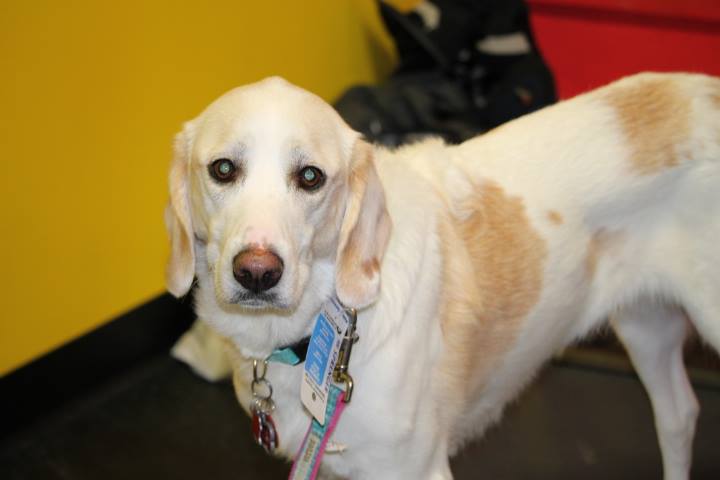
Fear is a common challenge for many dogs. Some dogs are nervous around strangers, while others become anxious around loud noises, unfamiliar places, other dogs, or new experiences. In some cases, dogs seem fearful of everyday life in general.
If you’re wondering how to help a fearful dog, it’s important to remember that fear is an emotional response—not a behaviour problem. Your dog isn’t trying to be difficult. They’re simply reacting to something they perceive as unsafe.
With patience, consistency, and the right training approach, you can help your dog feel more confident and secure.
Understanding Fear Responses in Dogs
When dogs feel afraid, their natural survival instincts take over. They typically respond in one of two ways: fight or flight.
Some fearful dogs try to increase distance from what scares them by barking, lunging, growling, or snapping. These behaviours are often described as “fear-based reactivity” because the dog is attempting to make the scary situation go away.
Other dogs choose to avoid the situation entirely by hiding, freezing, or trying to escape.
Although these responses look very different, both types of dogs share one thing in common: they lack confidence in the situation.
Understanding this can help you approach your dog’s behaviour with empathy rather than frustration.
Avoid Reinforcing Fearful Behaviour
When our dogs become scared, our natural instinct is often to comfort them by petting them, using a soothing voice, or repeatedly saying, “It’s okay.”
While offering calm support is important, excessive reassurance during moments of intense fear can sometimes increase your dog’s focus on the trigger.
Instead, aim to be a calm, confident presence.
Use a relaxed voice, maintain normal body language, and redirect your dog toward a simple behaviour they already know, such as making eye contact, touching your hand, or moving with you to a quieter space.
Your goal is not to ignore your dog’s emotions but to help them feel safe and supported without increasing their anxiety.
Respect Your Dog’s Threshold
One of the most important principles of fearful dog training is avoiding situations that overwhelm your dog.
Every dog has a threshold—the point at which a trigger becomes too intense for them to cope with calmly.
For example, if your dog reacts to other dogs during walks, pay attention to the distance at which they begin to bark, lunge, freeze, or show signs of stress.
If your dog reacts when another dog is 20 feet away, create more space and work at a distance where they can remain calm and focused.
Training below your dog’s threshold allows them to learn that they can feel safe around their triggers.
As your dog becomes more comfortable, gradually decrease the distance over time. Progress should always happen at your dog’s pace.
Remember:
- Never force your dog to approach something they fear.
- Give your dog enough space to stay calm.
- Watch for early signs of stress, such as lip licking, yawning, turning away, or a tucked tail.
- End training sessions before your dog becomes overwhelmed.
Book a Consultation
Build Confidence Through Training Games
Helping your dog become more confident in everyday life can make them more resilient when facing scary situations.
Instead of focusing only on the trigger itself, look for opportunities to build confidence in different ways.
Teaching new skills, solving simple challenges, and encouraging exploration can all help your dog feel more capable.
One effective confidence-building exercise is the “place” command. Encourage your dog to step onto different safe surfaces and objects, such as:
- A low platform or training cot
- A park bench
- A large rock
- A tree stump
Reward your dog for engaging with these new experiences at their own pace.
You can also try:
- Short training sessions with easy wins
- Food puzzles and enrichment activities
- Sniff walks in quiet environments
- Confidence-building obstacle courses
As your dog’s confidence grows, they’ll often become better equipped to handle situations that once felt overwhelming.
When to Seek Professional Help
If your dog’s fear leads to frequent barking, lunging, growling, snapping, or biting, it’s important to seek support from a qualified dog trainer or behaviour professional.
Early intervention can help prevent fearful behaviours from becoming more severe over time.
A professional can create a personalized training plan based on your dog’s specific triggers, body language, and comfort level.
Remember that progress with fearful dogs is rarely linear. Celebrate small successes and focus on steady improvement rather than quick fixes.
Helping Your Fearful Dog Thrive
Learning how to help a fearful dog starts with understanding their perspective.
By respecting your dog’s threshold, avoiding overwhelming situations, and building confidence through positive experiences, you can help them feel safer and more secure.
Patience, consistency, and compassion are the keys to long-term success.
Over time, your dog can learn that the world is a less scary place—and that they can rely on you for guidance and support.
Happy training!
Katherine
The Crunchy Canine
Hamilton, Ontario